
Key facts for commercial solar in London
| Network operator | UK Power Networks (its London, Eastern and South Eastern licence areas) |
| Indicative yield | About 850 to 1,000 kWh per kWp per year for a typical rooftop array |
| Planning regime | England: national permitted development rules, plus London Plan policy for major developments |
| Vehicle charging zones | London-wide ULEZ; Congestion Charge in central London |
| Nation support page | England (national schemes, see below) |
| City pages | This page covers all of Greater London |
Who runs the network in London
UK Power Networks operates the electricity distribution network across Greater London. Central London sits in its London licence area, while many outer boroughs fall within its Eastern or South Eastern areas. Licence boundaries do not follow borough or county lines exactly, so confirm the operator for your postcode with the Energy Networks Association postcode tool before you rely on anything else.
Very few commercial systems are small enough for G98 (up to 16A per phase, about 11.04 kW on a three phase supply), so most London projects need G99 approval before connecting. In a dense urban network, the capacity of the local substation and technical limits such as fault level can shape the offer you receive. Where full export is not available, an export limitation scheme under G100 can let a larger array connect while capping what it sends to the grid. Our G99 and DNO applications guide explains the process.
Import capacity matters as well. In 2022 the Greater London Authority warned that electricity capacity in parts of west London was constraining new development. If your plan includes EV charging or a battery that raises your import, the survey should flag whether a supply upgrade is likely.
How much a London roof produces
We modelled a 1 kWp array in central London in PVGIS (version 5.2, SARAH2 solar data, 14% system losses). Facing south at the optimum tilt of about 40 degrees it gives roughly 1,020 kWh a year. An east-west layout at 10 degrees, typical on a flat roof, gives roughly 840 kWh. Most real London roofs sit between those figures and often lower, because neighbouring buildings, parapets, lift overruns and rooftop plant cast shade for part of the day. Treat the range in the table as indicative; a survey models your actual roof.
Planning and policy in London
The national rules for England apply. Permitted development rights for non-domestic rooftop solar were widened in December 2023, including removal of the old 1 MW limit, but conditions still apply. London has a high concentration of conservation areas and listed buildings, where those conditions bite hardest, so check early. Our planning permission guide sets out the conditions.
The London Plan
The London Plan 2021 is the main policy that sets solar apart in the capital. Policy SI 2 expects major developments (for commercial schemes, generally 1,000 square metres or more of new floorspace) to be net zero carbon, with at least a 35% on-site reduction in regulated emissions beyond Building Regulations. It follows an energy hierarchy: be lean, be clean, be green and be seen. Any shortfall is usually met by a payment into the borough's carbon offset fund, and the "be seen" step requires energy performance to be monitored after occupation.
For an existing building that is not undergoing major development, the London Plan does not require you to fit solar, though individual borough policies vary. For a refurbishment or extension that counts as major development, rooftop PV is often one of the more practical ways to meet the "be green" stage.
The Mayor published a draft new London Plan on 16 July 2026. Consultation closed on 15 October 2026 and examination is expected in 2027. Until a new plan is adopted, the 2021 plan remains in force, so check whether the energy policies change at examination.
ULEZ and the Congestion Charge
The Ultra Low Emission Zone has covered all London boroughs since 29 August 2023. The Congestion Charge exemption for electric vehicles ended on 25 December 2025; electric vehicles registered for Auto Pay now get a discount rather than paying nothing. Both changes push fleet operators towards electric vans and cars, and daytime depot charging pairs well with rooftop generation. See EV charging for business.
London's commercial building stock
London's industrial land is concentrated in places such as Park Royal in the west, the Lea Valley, and the Thames-side and Royal Docks areas in the east, along with the logistics belt around Heathrow. Many of these sites are multi-let estates, so the roof owner and the electricity user are often different businesses. That makes the lease, the landlord's consent and who benefits from the power central to the project; our page for commercial landlords covers the options.
Offices, schools, hospitals and retail make up much of the rest. Office roofs in London are often small relative to the building's electricity demand, so nearly all generation is used on site, which helps the payback even where the array is modest.
Support and finance in London
London businesses use the same national schemes as the rest of England: capital allowances, the business rates exemption for eligible onsite generation and storage plant (to 31 March 2035), and the Smart Export Guarantee for exported power. See grants and support in England, and confirm tax treatment with your accountant.
How the free survey works in London
You complete the short form and we call to understand the building, the lease and your electricity use. If the site looks suitable, we arrange a free survey with one MCS certified installer matched to the site. In London a virtual first look using drawings, aerial imagery and your half-hourly data is common, followed by a roof visit once building management and access are agreed. Your details go to that one installer only, and there is no obligation to proceed. See how a survey works.
Frequently asked questions
Do I need planning permission for solar on a commercial roof in London?
Often not. National permitted development rights in England cover most non-domestic rooftop solar, subject to conditions such as height above a flat roof. London has many conservation areas and listed buildings, though, and those conditions are stricter there. Check your building's status with the borough early, and ask the installer to confirm before design work is finalised.
Does the London Plan require me to put solar on my existing building?
Not on its own. Policy SI 2 applies to major developments, such as large extensions or redevelopments, which must reach net zero carbon with at least a 35% on-site reduction beyond Building Regulations. If you are simply adding panels to an existing building, the London Plan does not compel you, although borough policies and your own carbon targets may still make it worthwhile.
Who is the electricity network operator for my London site?
Across Greater London it is UK Power Networks, though your site may sit in its London, Eastern or South Eastern licence area depending on the borough. The boundaries do not follow borough lines exactly, so use the Energy Networks Association postcode tool to confirm. The licence area matters because it determines which team handles your G99 application.
How do ULEZ and the Congestion Charge affect a solar decision?
They do not affect the panels directly, but they change fleet economics. With London-wide ULEZ and the end of the full Congestion Charge exemption for electric vehicles, many operators are moving to electric vans. Charging them in the daytime at a depot with rooftop solar can use generation that would otherwise be exported, so the survey should consider both together.
Can a tenant in a London multi-let building request a survey?
Yes. Many London enquiries come from tenants. The survey looks at the roof, your demand and the connection, but the landlord's consent and the lease terms decide whether a project can go ahead. It helps to tell us at the start who owns the roof and how long is left on your lease.
Related pages
- G99 and DNO applicationsG98 versus G99, what goes into a DNO application, connection offers, export limitation under G100, reinforcement costs and how the survey checks your supply.
- Planning permissionPermitted development for commercial rooftop solar and car park canopies in England, prior approval, heritage limits, ground-mounted schemes and the other UK nations.
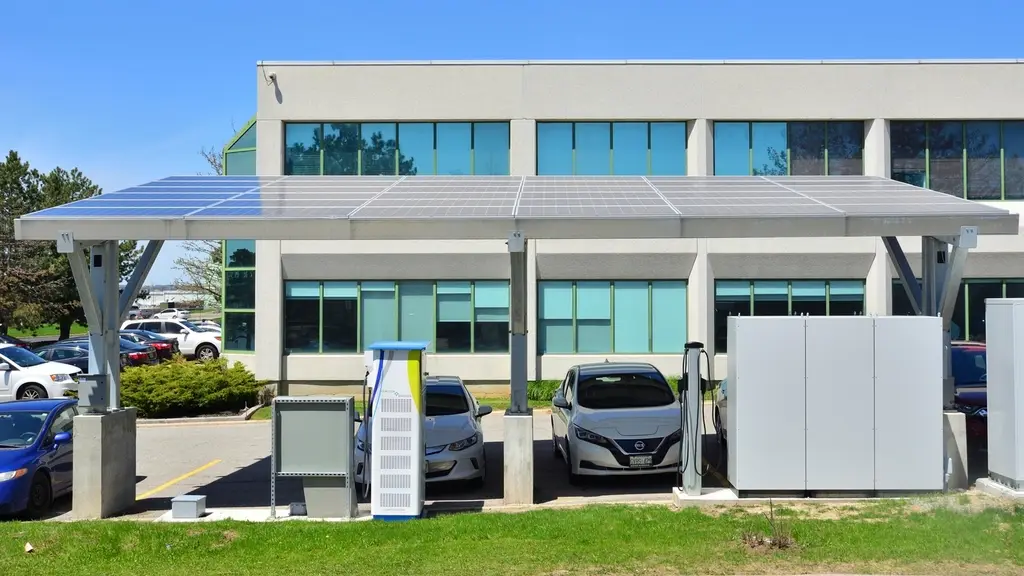 EV chargingHow to plan workplace and fleet EV charging with solar: supply capacity, load management, charger types, matching generation to charging and grant support.
- Commercial landlordsSolar on let property means settling who pays, who benefits and who owns the system. This page covers the main ownership models, lease length, metering and MEES.
- EnglandCurrent solar support in England for businesses, schools, public bodies, community groups and farms, plus rates, planning and who to contact.