
Key facts for commercial solar in the East Midlands
| Network operator | National Grid Electricity Distribution (most of the region) |
| Indicative yield | About 825 to 975 kWh per kWp per year for a typical rooftop array |
| Planning regime | England: national permitted development rules |
| Local transport charges | Nottingham Workplace Parking Levy; no charging clean air zones |
| Nation support page | England (national schemes, see below) |
| City pages | Nottingham |
The network in the East Midlands
National Grid Electricity Distribution (NGED) runs the network across most of the East Midlands: Derbyshire, Nottinghamshire, Leicestershire, Rutland, Northamptonshire and most of Lincolnshire. Some sites near the region's northern and western edges fall into neighbouring operators' areas, because licence boundaries do not follow county lines. Confirm yours with the Energy Networks Association postcode tool.
Large warehouses are the main connection challenge here. A distribution centre with a big roof can host an array far larger than its daytime demand, and the operator may not accept full export. The usual answer is to size the array to the site's use, apply an export limitation scheme under G100, or add a battery. Anything above G98 limits needs G99 approval; our G99 and DNO applications guide explains how.
Yield in the East Midlands
In our PVGIS model (version 5.2, SARAH2 data, 14% system losses), a south-facing 1 kWp array at the optimum tilt in Nottingham gives about 980 kWh a year, and an east-west layout at 10 degrees about 810 kWh. Lincolnshire sites model a little higher, with about 1,020 kWh for the south-facing case near Lincoln. Warehouse roofs are usually low pitch, so many arrays here are laid out east-west at shallow angles and sit towards the lower end of the range, while fitting more panels in.
Planning and local policy
Planning follows the national rules for England, including the December 2023 widening of permitted development for non-domestic rooftop solar. Most of the Peak District National Park lies in Derbyshire, and the Lincolnshire Wolds is a National Landscape; conditions are tighter there. Lincolnshire has seen a number of large ground-mounted solar proposals, so ground-mounted schemes on farmland attract close local scrutiny. See our planning permission guide.
There are no charging clean air zones in the East Midlands. Nottingham does operate a Workplace Parking Levy: employers in the city providing 11 or more liable parking places pay a charge per place each year (£570 per place for 2025 to 2026, per Nottingham City Council). The levy is a reason some Nottingham employers review travel and fleet arrangements, and a solar carport can make better use of a car park you are already paying for. See solar carports.
Buildings and economy that suit solar
- The Golden Triangle. The area between the M1, M6 and A14 is one of the UK's main warehousing locations, with large rail-linked and road-based parks such as DIRFT near Daventry and Magna Park near Lutterworth. These roofs are among the biggest in the country. See our warehouses page. Two practical points come up repeatedly on these buildings. Some large warehouses were designed with little spare roof load capacity, so lightweight mounting or strengthening may be needed, and a structural engineer confirms what the roof can carry. Most are also leased, often to logistics operators, so the landlord and occupier need to agree who pays for the system and who benefits from the power.
- East Midlands Airport. It is one of the UK's busiest airports for air cargo, with express parcel hubs and logistics around it.
- Manufacturing. Derby has major engineering employers in aerospace, rail and car manufacturing, including Rolls-Royce and Toyota's Burnaston plant. Leicester and Nottingham have food manufacturing, textiles and engineering. See our factories page.
- Lincolnshire farming and food. Lincolnshire is one of England's main arable and vegetable growing areas, and the area around Spalding and Boston is a centre for vegetable packing, flowers and food processing, with chilled storage running year round. See food and drink.
Support and finance
East Midlands businesses use the national schemes for England: capital allowances, the business rates exemption for eligible onsite generation and storage plant to 31 March 2035, and the Smart Export Guarantee. See grants and support in England, and confirm tax treatment with your accountant.
Cities with their own page
- Nottingham: the Workplace Parking Levy, city centre buildings and nearby industrial estates.
How the free survey works in the East Midlands
Complete the short form and we will call to discuss your site, your lease if you are a tenant, and your electricity use. If it looks suitable, we arrange a free survey, in person or virtual, with one MCS certified installer matched to the site. For large warehouses the installer will usually check roof loading and the supply capacity first, since those set the practical system size. Your details go to that one installer only, and you are under no obligation to proceed.
Cities in East Midlands
Frequently asked questions
Our warehouse roof could take far more panels than we need. What happens?
You have choices. The array can be sized to your daytime demand, connected with an export limit under G100, or paired with a battery. Some landlords and occupiers also look at power purchase agreements where a third party funds a larger array. The G99 application will show how much export the operator can accept at your site.
Does the Nottingham Workplace Parking Levy affect solar?
Not directly. The levy is a charge on employers providing 11 or more liable parking places in the city. It can prompt a review of how the car park is used, and some employers look at solar carports over existing spaces so the land does double duty. Carports need structural design and may need planning, so the survey checks both.
Is the East Midlands sunny enough for solar to pay back?
Yes. Yields are a little below southern England but well within the range used for UK payback calculations. The bigger factors are how much of the generation you use on site, your unit rate and the installed cost. In the Golden Triangle, large roofs and long operating hours usually mean a high share of output is used on site.
Who handles grid connections in Lincolnshire?
Most of Lincolnshire is served by National Grid Electricity Distribution. The far north of the county, which is in the Yorkshire and the Humber region, and some border areas can fall under Northern Powergrid. Use the Energy Networks Association postcode tool to confirm, since this decides who reviews your G99 application.
Related pages
- NottinghamNGED East Midlands grid approvals, planning across Nottingham, Broxtowe and Rushcliffe, the Workplace Parking Levy and the city's lace warehouses and modern sheds.
- WarehousesLarge unshaded roofs and daytime shift work make many warehouses a strong fit for rooftop solar, provided the roof structure, rooflights and lease terms stack up.
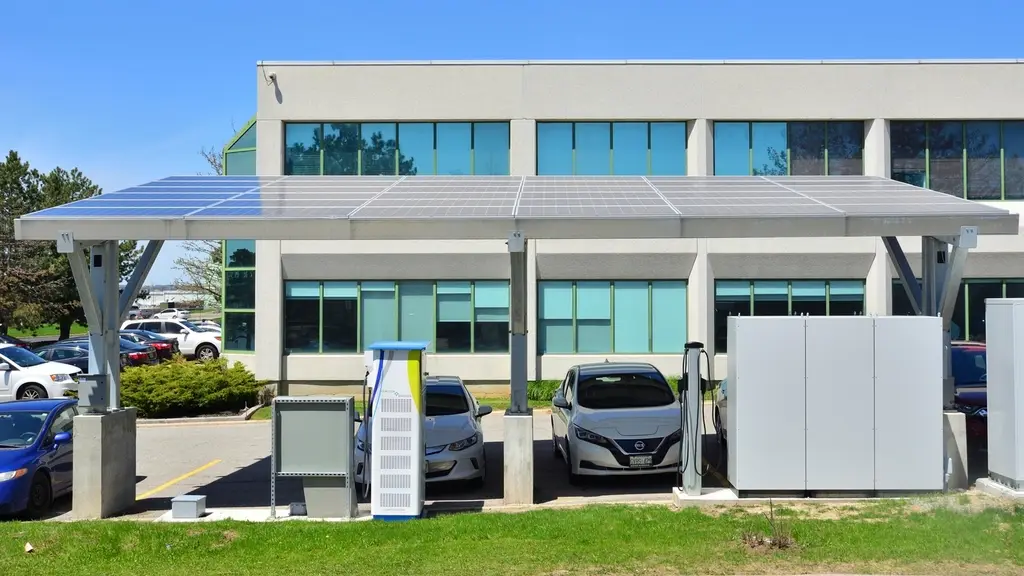 Solar carportsSolar car park canopies: permitted development in England, foundations and drainage, structural design, EV charging and how costs compare with rooftop solar.
- G99 and DNO applicationsG98 versus G99, what goes into a DNO application, connection offers, export limitation under G100, reinforcement costs and how the survey checks your supply.
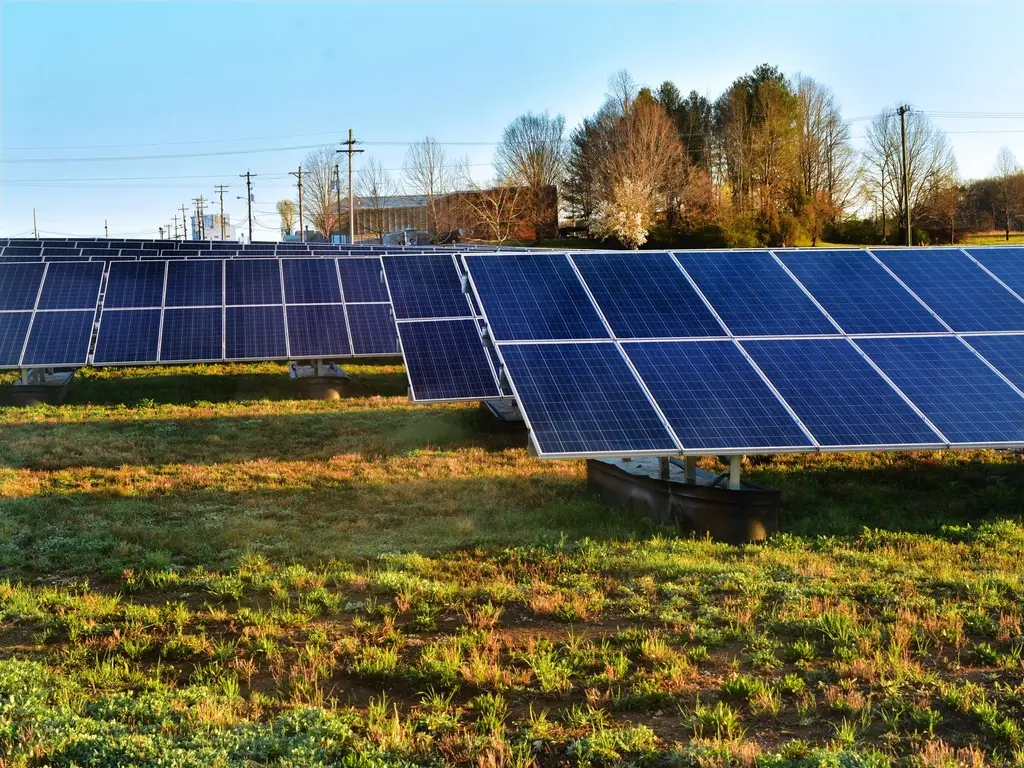 Power purchase agreementsHow on-site solar PPAs work, typical contract lengths, how prices rise over time, what happens if you sell or move, and the clauses to check before signing.
- EnglandCurrent solar support in England for businesses, schools, public bodies, community groups and farms, plus rates, planning and who to contact.