
Key facts for commercial solar in the North East
| Network operator | Northern Powergrid (Northeast licence area) |
| Indicative yield | About 800 to 925 kWh per kWp per year for a typical rooftop array |
| Planning regime | England: national permitted development rules |
| Vehicle charging zones | Tyneside Clean Air Zone, Newcastle and Gateshead (Class C) |
| Nation support page | England (national schemes, see below) |
| City pages | Newcastle |
The network in the North East
Northern Powergrid runs the distribution network across the North East through its Northeast licence area, covering Northumberland, Tyne and Wear, County Durham and Teesside, and extending into parts of North Yorkshire. Its separate Yorkshire licence area covers most of Yorkshire. Licence boundaries do not follow county lines, so confirm your operator and licence area with the Energy Networks Association postcode tool.
Commercial systems above G98 limits need G99 approval before connection. Heavy industrial users on Teesside are often connected at higher voltages, which changes the application and the protection requirements. Rural sites in Northumberland and the Durham dales can be at the end of long lines with less capacity for export, where an export limitation scheme under G100 or a battery may be the practical route. Our G99 and DNO applications guide covers these options.
Yield in the North East
The east coast is drier than the west, so the North East does better than its latitude might suggest. In our PVGIS model (version 5.2, SARAH2 data, 14% system losses), a south-facing 1 kWp array at the optimum tilt in Newcastle gives about 950 kWh a year, and an east-west layout at 10 degrees about 760 kWh. That south-facing figure is higher than our Manchester result. Low-pitch east-west warehouse arrays can come in below 800 kWh per kWp, so the survey should model your roof rather than assume a national average.
Seasonal swing is larger this far north. Long summer days give strong output from May to August, while December produces only a small fraction of a June month. A site whose demand peaks in winter will export more of its summer generation, which affects both sizing and whether a battery makes sense.
Planning and the Tyneside Clean Air Zone
Planning follows the national rules for England, including the December 2023 widening of permitted development for non-domestic rooftop solar. Northumberland National Park, the North Pennines and Northumberland Coast National Landscapes, and Hadrian's Wall World Heritage Site all bring tighter conditions, particularly for ground-mounted arrays. See our planning permission guide.
Newcastle and Gateshead operate the Tyneside Clean Air Zone, a Class C zone covering central Newcastle and the Tyne crossings. It charges non-compliant buses, coaches, taxis, private hire vehicles, HGVs, vans and minibuses, but not private cars. Businesses running older vans or lorries through the zone have a direct reason to look at electric vehicles, and depot charging can be planned alongside rooftop solar. See EV charging for business.
Buildings and economy that suit solar
- Car manufacturing. Nissan's plant in Sunderland is one of the UK's largest car factories, and the surrounding supplier base, including the International Advanced Manufacturing Park, brings modern industrial buildings with large roofs.
- Teesside process industry. Teesside has a long history of chemicals and steel, with sites such as Wilton International, and the Teesworks redevelopment on the former Redcar steelworks land. High, continuous loads mean almost all generation is used on site.
- Ports. Teesport and the Port of Tyne support distribution and manufacturing; the Teesside Freeport covers land around the Tees.
- Trading estates. Team Valley in Gateshead and similar estates across the region provide multi-let industrial and trade counter units, where landlord and tenant arrangements matter. See our commercial landlords page.
- Farming. Northumberland and County Durham have large livestock and arable farms with machinery sheds and grain stores, many in exposed upland locations where wind loading on the roof needs particular attention. See our farms page.
Support and finance
North East businesses use the national schemes for England: capital allowances, the business rates exemption for eligible onsite generation and storage plant to 31 March 2035, and the Smart Export Guarantee. See grants and support in England and confirm tax treatment with your accountant.
Cities with their own page
- Newcastle: the Clean Air Zone, Tyneside's industrial estates and city centre buildings.
How the free survey works in the North East
Use the short form and we will call to understand the building, the supply and your electricity use. If it looks suitable, we arrange a free survey, in person or virtual, with one MCS certified installer matched to the site. Coastal sites here face strong winds and salt air, so the installer should check fixings, wind loading and corrosion protection as part of the design. Your details go to that one installer only, with no obligation to proceed.
Cities in North East
Frequently asked questions
Who is the network operator in the North East?
Northern Powergrid, through its Northeast licence area, which covers Northumberland, Tyne and Wear, County Durham, Teesside and parts of North Yorkshire. Its Yorkshire licence area is separate. Because the boundaries do not follow county lines, confirm your site with the Energy Networks Association postcode tool before an installer prepares a G99 application.
Which vehicles are charged in the Tyneside Clean Air Zone?
The Newcastle and Gateshead zone is Class C, so non-compliant buses, coaches, taxis, private hire vehicles, HGVs, vans and minibuses are charged. Private cars are not. If your vans regularly cross the Tyne bridges or enter central Newcastle, switching to electric removes the charge, and charging on site with solar can make better use of your generation.
Does solar work this far north?
Yes. The North East is drier than the west coast, and our PVGIS modelling for Newcastle gives a south-facing yield of about 950 kWh per kWp a year, which is comparable to parts of the Midlands. Industrial sites with steady daytime loads use most of what they generate, which is what drives payback.
We are on the coast. Does that change the design?
It can. Coastal sites see higher wind loads and salt-laden air, which affect the choice of fixings, rail materials and inverter enclosures, and sometimes the layout near roof edges. A roof survey and wind load calculation are part of a sound design, and manufacturers' warranties may have conditions for coastal installations, which the installer should check.
Related pages
- NewcastleNorthern Powergrid G99 approvals, planning across Newcastle, Gateshead and North Tyneside, the Class C Clean Air Zone and Tyneside's industrial roofs.
- G99 and DNO applicationsG98 versus G99, what goes into a DNO application, connection offers, export limitation under G100, reinforcement costs and how the survey checks your supply.
- FactoriesFactories with heavy daytime process loads can use nearly all the solar they generate. The survey focuses on the electrical system, roof condition and how to install without stopping production.
- Roof surveyHow a solar roof survey assesses covering type, condition and remaining life, fragility and safe access, shading, orientation, drainage and existing warranties.
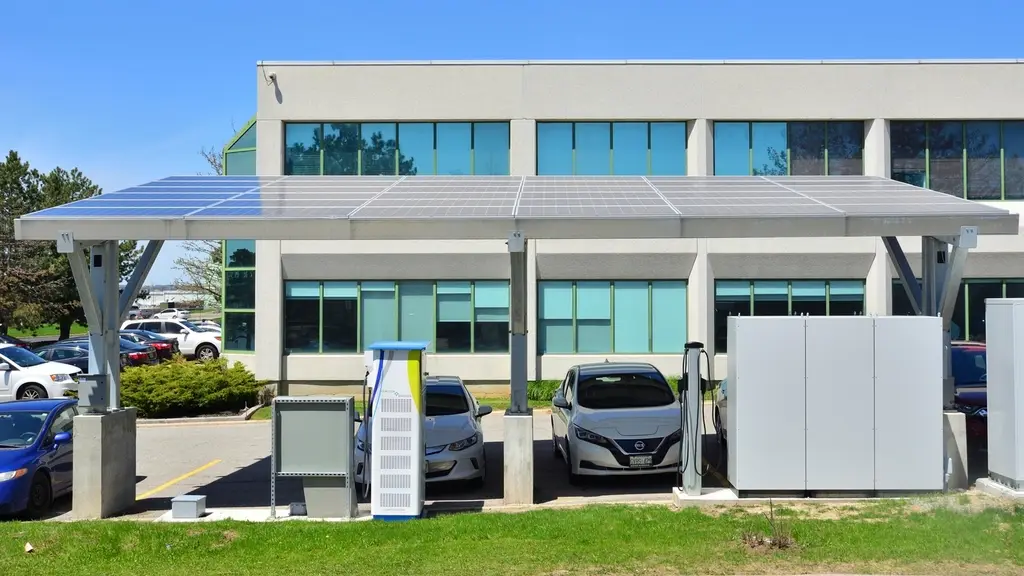 EV chargingHow to plan workplace and fleet EV charging with solar: supply capacity, load management, charger types, matching generation to charging and grant support.
- EnglandCurrent solar support in England for businesses, schools, public bodies, community groups and farms, plus rates, planning and who to contact.