
Key facts for commercial solar in Scotland
| Network operators | SP Energy Networks (central and southern Scotland); Scottish and Southern Electricity Networks (north of Scotland) |
| Indicative yield | About 800 to 900 kWh per kWp per year for a well-oriented roof in the central belt and east; lower in the far north and west |
| Planning regime | Scotland: National Planning Framework 4 and the Scottish permitted development order |
| Vehicle charging zones | Low emission zones in Glasgow, Edinburgh, Aberdeen and Dundee |
| Business rates | Scottish exemption for eligible onsite generation and storage plant to 31 March 2035 |
| Nation support page | Scotland (see below) |
| City pages | Glasgow, Edinburgh, Aberdeen |
Two network operators
SP Energy Networks runs the distribution network across central and southern Scotland, including Glasgow, Edinburgh, Fife, Ayrshire, Lanarkshire, Dumfries and Galloway and the Borders. Scottish and Southern Electricity Networks (SSEN) runs the north of Scotland network, broadly from Tayside and Argyll northwards: Perth, Dundee, Aberdeen, the Highlands and the islands. Licence boundaries do not follow council boundaries exactly, so confirm your operator with the Energy Networks Association postcode tool.
G98 and G99 apply in Scotland just as they do in England and Wales: small systems up to 16A per phase notify after installation, while larger systems need G99 approval before connecting. The difference is the network. Much of the north is served by long rural lines and island networks with limited capacity, and parts of Scotland already host a lot of renewable generation, so export capacity can be tight. Designing around on-site use, an export limitation scheme under G100 or a battery is common. See our G99 and DNO applications guide.
What Scottish roofs produce
Scotland's yields are the lowest in Great Britain, but they vary a lot from place to place. In our PVGIS model (version 5.2, SARAH2 data, 14% system losses), a south-facing 1 kWp array at the optimum tilt gives about:
| Location | South-facing, optimum tilt | East-west, 10 degrees |
|---|---|---|
| Edinburgh | about 920 kWh | not modelled |
| Aberdeen | about 900 kWh | not modelled |
| Glasgow | about 860 kWh | about 710 kWh |
| Inverness | about 810 kWh | about 670 kWh |
The east coast is noticeably sunnier than the west. Long summer days help, but winter output is very low. Flat roof east-west layouts in Scotland can fall well below 800 kWh per kWp, so a south-facing tilted layout may be worth the extra ballast or framing. All figures are indicative; a survey models your roof.
Planning in Scotland
Scotland has a separate planning system. National Planning Framework 4 (NPF4), adopted in February 2023, is the national planning policy and gives significant weight to the climate emergency and to renewable energy development. Local development plans sit alongside it.
Permitted development for non-domestic solar is set by the Scottish permitted development order, not the English rules. Changes that came into force in 2024 removed the previous 50 kW cap on rooftop solar on non-domestic buildings, so most rooftop systems no longer need planning permission, subject to conditions. Listed buildings and World Heritage Sites, such as Edinburgh's Old and New Towns, are excluded, and conservation areas have restrictions on roof slopes facing a road. Our planning permission guide covers the general principles.
TODO for the site owner: Confirm the current Scottish permitted development conditions for non-domestic rooftop solar (height above a flat roof, conservation area rules, ground-mounted limits) against the latest consolidated order on legislation.gov.uk.
Building warrants, which are separate from planning, may also be needed for some installations in Scotland, particularly where the roof structure is altered.
Low emission zones
Scotland's four city low emission zones are all enforced: Glasgow from 1 June 2023, and Dundee, Aberdeen and Edinburgh from mid-2024. Unlike most English clean air zones, they set minimum standards for private cars as well as commercial vehicles, and non-compliant vehicles face penalty charges rather than a daily fee. Fully electric vehicles are not restricted. For businesses running vans or lorries into these city centres, the zones strengthen the case for electric vehicles and on-site charging. See EV charging for business.
Business rates and support
Scotland's non-domestic rates are set by the Scottish Government. Eligible plant and machinery used for on-site renewable generation and storage, such as rooftop solar panels, is exempt from rating from 1 April 2023 to 31 March 2035. Scotland also has a separate Renewable Energy Generation Relief for schemes with community ownership. The Smart Export Guarantee applies in Scotland as in the rest of Great Britain. For loans and advice schemes, see grants and support in Scotland, and confirm tax and rates treatment with your accountant and your local assessor.
Scotland's commercial buildings
- Food and drink. Whisky distilleries in Speyside, Islay and elsewhere, fish processing at Peterhead and in the north east, and meat and dairy processing run large daytime loads.
- Farming. Arable farming in the east (Fife, Angus, the Lothians and Aberdeenshire) and livestock in the south and west mean grain stores, cattle sheds and potato stores with large roofs. See our farms page.
- Energy and engineering. Aberdeen's energy sector, and the industrial sites around Grangemouth and the Forth, include large workshops and warehouses.
- Logistics and manufacturing. The central belt along the M8, M73 and M80 is Scotland's main distribution corridor, with large warehouses near Glasgow, Livingston and Bathgate.
Cities with their own page
- Glasgow: the first Scottish low emission zone and the west of Scotland's industrial estates.
- Edinburgh: World Heritage Site constraints, offices and the Lothians.
- Aberdeen: the energy sector, SSEN connections and the north east.
How the free survey works in Scotland
Send the short form and we will call to understand your site and use. If it looks suitable, we arrange a free survey with one MCS certified installer matched to the site, ideally one familiar with the relevant operator and Scottish planning rules. For remote Highland and island sites, a virtual assessment using aerial imagery and meter data is often the sensible first step before anyone travels. Your details go to that installer only, and you are under no obligation to proceed.
Cities in Scotland
- GlasgowSP Energy Networks G99 approvals, Scottish permitted development, the city centre Low Emission Zone and roofs from Hillington Park to Eurocentral.
- EdinburghSP Energy Networks G99 approvals, World Heritage Site and listed building planning, the Low Emission Zone, and roofs at Leith, Newbridge and the business parks.
- AberdeenSSEN G99 approvals in the north of Scotland, planning across Aberdeen City and Aberdeenshire, the Low Emission Zone and energy industry roofs at Dyce, Altens and Tullos.
Frequently asked questions
Do I need planning permission for solar on a business roof in Scotland?
Usually not, since changes in 2024 removed the 50 kW cap on permitted development for rooftop solar on non-domestic buildings. Conditions still apply: listed buildings and World Heritage Sites are excluded, and conservation areas restrict panels on roof slopes facing a road. Check with your planning authority if your building is in a protected area, and ask whether a building warrant is needed.
Who is my network operator in Scotland?
Central and southern Scotland, including Glasgow and Edinburgh, is SP Energy Networks. The north, broadly from Tayside and Argyll northwards, including Aberdeen, Inverness and the islands, is SSEN. Boundaries do not follow council lines exactly, so check with the Energy Networks Association postcode tool before an installer prepares your G99 application.
Is solar worth it in Scotland given the lower sunshine?
It can be. Yields are around 10% to 25% lower than southern England, but payback depends mostly on how much generation you use on site and your unit rate. Sites with steady daytime demand, such as distilleries, food processors and cold stores, often use nearly all of their output. Scotland's rates exemption for onsite generation also helps the numbers.
Are solar panels exempt from business rates in Scotland?
Eligible plant and machinery used for on-site renewable generation and storage, including rooftop solar, is exempt from rating in Scotland from 1 April 2023 to 31 March 2035. This is a Scottish measure, separate from the English exemption. Confirm with your local assessor and accountant how it applies to your property, particularly if you are a tenant.
Do Scottish low emission zones affect vans?
Yes. The zones in Glasgow, Edinburgh, Aberdeen and Dundee set minimum emission standards for most vehicles, including vans and cars, with penalty charges for non-compliant vehicles. Fully electric vans are not restricted. If your fleet serves these city centres, electric vans charged at your own site with solar can be a practical combination.
Related pages
- GlasgowSP Energy Networks G99 approvals, Scottish permitted development, the city centre Low Emission Zone and roofs from Hillington Park to Eurocentral.
- EdinburghSP Energy Networks G99 approvals, World Heritage Site and listed building planning, the Low Emission Zone, and roofs at Leith, Newbridge and the business parks.
- AberdeenSSEN G99 approvals in the north of Scotland, planning across Aberdeen City and Aberdeenshire, the Low Emission Zone and energy industry roofs at Dyce, Altens and Tullos.
- ScotlandCurrent solar support in Scotland for businesses, community groups, public bodies, schools and farms, with rates, planning and official contacts.
- G99 and DNO applicationsG98 versus G99, what goes into a DNO application, connection offers, export limitation under G100, reinforcement costs and how the survey checks your supply.
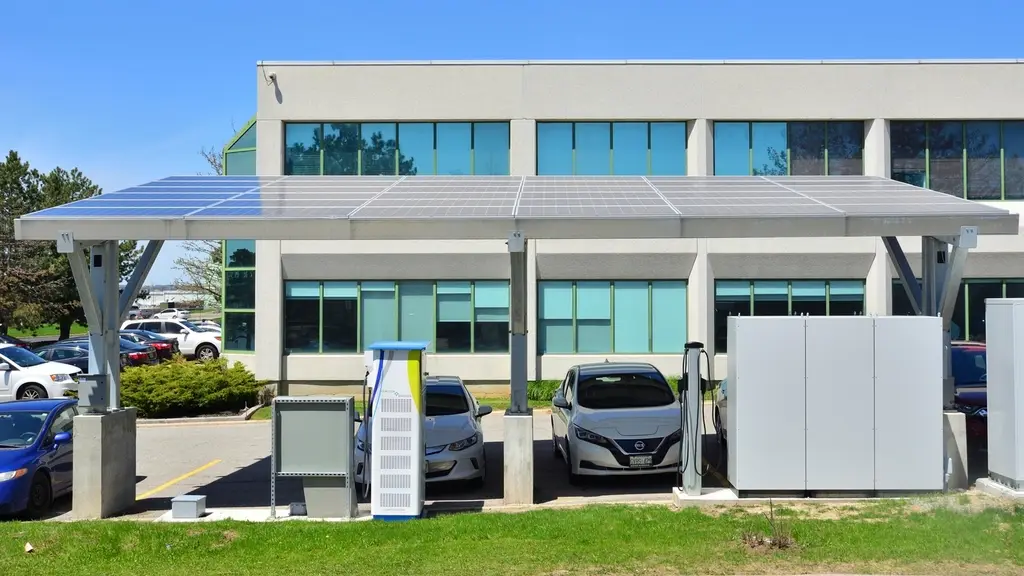 EV chargingHow to plan workplace and fleet EV charging with solar: supply capacity, load management, charger types, matching generation to charging and grant support.