
Key facts
| Network operator | SP Electricity North West (formerly Electricity North West) |
| Planning authority | Manchester City Council; Trafford Council for Trafford Park; Salford City Council for Port Salford and MediaCityUK; the other Greater Manchester boroughs for their own areas |
| Clean air zone | No charging clean air zone; government agreed an investment-led plan in January 2025 |
| Indicative yield | About 800 to 880 kWh per kWp a year for a well-oriented array |
| Nation support page | Grants and support in England |
Grid connection with SP Electricity North West
The distribution network across Greater Manchester, Lancashire and Cumbria is run by Electricity North West, which became part of the Iberdrola group and has traded as SP Electricity North West since August 2025. You may still see the old name on paperwork and substations. Any commercial system above the G98 limits needs G99 approval from the operator before it connects. Licence boundaries can vary at the edges of the city region, so check your postcode with the Energy Networks Association postcode tool.
Note that Merseyside, including Liverpool, is a different licence area run by SP Energy Networks. If your business has sites on both sides of the region, expect two separate applications with different operators. Our guide to G99 and DNO applications explains the process and where export limitation can help.
Planning across the city region
Manchester City Council decides applications in the city itself, including Airport City and the land around Manchester Airport. Many of the largest industrial sites, though, are in neighbouring boroughs:
- Trafford Park, the long-established industrial estate beside the Manchester Ship Canal, is in Trafford, so Trafford Council is the planning authority.
- Port Salford and MediaCityUK fall to Salford City Council.
- Kingsway Business Park and the Heywood distribution sites sit in Rochdale.
England's permitted development rights for non-domestic rooftop solar were widened in December 2023, with the previous 1 MW limit removed. Conditions still apply, including limits on height above a flat roof and tighter rules for listed buildings and conservation areas, of which Manchester has many in its former mill districts.
The local economy and commercial solar
Greater Manchester's economy spans logistics and distribution, manufacturing and food processing, digital and media, health, universities and a large office market. For solar, the strongest candidates are usually businesses that use most of their power during the day: manufacturers and food producers in Trafford Park, distribution operations around the M60, M62 and the airport, and hospitals and campuses with high, steady demand.
Clean air plan and vehicle charging
Greater Manchester does not have a charging clean air zone. In January 2025 the government agreed that a charging zone was not necessary and approved the city region's investment-led plan instead. That means no daily charge to factor in, but fleet electrification is still a common reason to look at solar: a depot that charges vans during the day can use far more of its own generation. See EV charging for business for how charging and solar are sized together.
Roofs and buildings in Manchester
- Victorian cotton mills and warehouses in Ancoats, Castlefield and the Northern Quarter. Many are listed or in conservation areas, and roofs range from slate pitches to multi-span valleys. A structural survey is important on older timber or cast-iron frames.
- 1960s to 1980s industrial units in Trafford Park, Openshaw and across the boroughs, often with asbestos cement sheeting that needs surveying before any work; see asbestos roofs.
- Modern distribution sheds at Port Salford, Airport City and Kingsway, with large metal roofs that suit rail-mounted panels.
Expected generation
Manchester is cloudier than much of England, partly because of its position west of the Pennines. A well-oriented commercial array typically produces about 800 to 880 kWh per kWp a year (indicative). The European Commission's PVGIS model gives close to 890 kWh per kWp for an ideally angled, south-facing array with standard losses, and nearer 725 for a low-pitch east-west flat roof layout. On a large shed the extra panels an east-west layout allows can still produce more in total.
How the free survey works here
Tell us about your site using the short form. We review it, call you to understand the building and how you use energy, and if it looks suitable we arrange a free survey with one MCS certified installer matched to the site. Your details go to that installer only. Converted mills usually benefit from an in-person visit, while a modern shed with good drawings can often start with a virtual survey. There is no obligation. Our North West page covers the wider region.
Frequently asked questions
Is Electricity North West still the network operator for Manchester?
The same company still runs the network, but it is now part of the Iberdrola group and has traded as SP Electricity North West since August 2025. It handles G99 applications for commercial solar across Greater Manchester, Lancashire and Cumbria. Older documents and signs may still use the previous name. Confirm your operator with the Energy Networks Association postcode tool.
Who decides planning for a unit on Trafford Park?
Trafford Council, not Manchester City Council, because Trafford Park lies in the borough of Trafford. Most rooftop systems on industrial units can go ahead under permitted development, subject to the national conditions. If your building is listed or the panels would sit well above a flat roof, ask Trafford's planning team whether an application is needed.
Is solar worth it in Manchester given the weather?
Yields are lower than in southern England, but the economics depend mostly on how much generation you use on site and your own unit rate. A typical well-oriented array here produces about 800 to 880 kWh per kWp a year (indicative). For a business using most of that during the day, the saving per unit is the same as anywhere else.
Can panels go on a converted mill in Ancoats?
Sometimes. Many Ancoats mills are listed or within a conservation area, so listed building consent or planning permission may be needed, and the roof structure must be checked carefully. Flat roof sections and valleys hidden from the street are the most likely options. An in-person survey is usually the right first step for these buildings.
Related pages
- North WestTwo network operators, realistic northern yields, Trafford Park, the Port of Liverpool, Cheshire chemicals and Cumbrian farming, and Greater Manchester's non-charging clean air plan.
- LiverpoolSP Energy Networks G99 approvals, planning across Liverpool, Sefton, Knowsley and Wirral, port and logistics roofs and listed dock buildings.
- LeedsNorthern Powergrid G99 approvals, planning across Leeds and neighbouring West Yorkshire councils, Aire Valley and M62 logistics roofs and listed mill buildings.
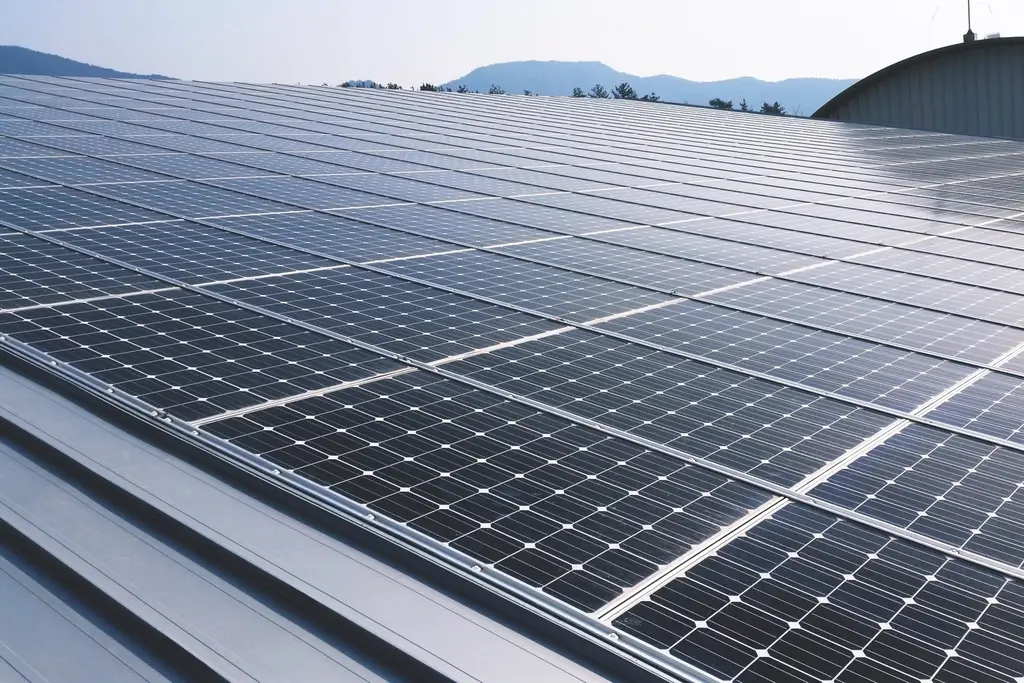 Metal roofsTrapezoidal, standing seam and composite panel roofs: how mounting, rooflights, fixings and sheet age affect a solar installation.
- G99 and DNO applicationsG98 versus G99, what goes into a DNO application, connection offers, export limitation under G100, reinforcement costs and how the survey checks your supply.