
Key facts
| Network operator | National Grid Electricity Distribution (East Midlands licence area) |
| Planning authority | Nottingham City Council; Broxtowe, Rushcliffe and Gedling borough councils for the surrounding suburbs |
| Clean air zone | No charging clean air zone; ministers approved a non-charging air quality plan in 2018 |
| Indicative yield | About 860 to 960 kWh per kWp a year for a well-oriented array |
| Nation support page | Grants and support in England |
Grid connection with National Grid Electricity Distribution
Nottingham is in the East Midlands licence area of National Grid Electricity Distribution (NGED). Commercial systems above the G98 limits need G99 approval before they connect. Boundaries can vary at the edges of licence areas, so confirm your operator with the Energy Networks Association postcode tool.
Business parks around the city, and the large logistics sites near the M1, often have modern supplies, but export capacity still varies by substation. Where export is limited, an export limitation scheme under G100 or a battery can allow a larger array. Our page on G99 and DNO applications explains the process.
Planning in and around Nottingham
Nottingham City Council covers a tightly drawn city area, so many of the employment sites people think of as Nottingham sit in neighbouring boroughs. The Boots campus straddles the boundary between the city and Broxtowe, and its redevelopment as part of the Nottingham Enterprise Zone was approved by both councils. Beeston Business Park is in Broxtowe. To the south, Rushcliffe covers the former Ratcliffe-on-Soar power station site, part of the East Midlands Freeport, while East Midlands Airport, a major air cargo hub, is over the county line in North West Leicestershire.
England's permitted development rights for non-domestic rooftop solar were widened in December 2023 and the 1 MW limit removed, with conditions for flat roof height, listed buildings and conservation areas. The Lace Market, with its Victorian lace warehouses, is a conservation area with many listed buildings. Our planning permission guide explains the conditions.
The local economy and solar
Nottingham's economy includes health and life sciences, retail and consumer goods, professional services, two universities, the Queen's Medical Centre and wider hospital estate, manufacturing and logistics along the M1. Campuses, hospitals and manufacturers with heavy weekday demand tend to use most of their generation on site. Distribution sites near the motorway have large roofs that suit big arrays; see warehouses.
Clean air, the Workplace Parking Levy and EV charging
Nottingham does not have a charging clean air zone. In 2018 ministers approved the city's air quality plan, which relied on cleaner buses and taxi measures rather than a charging zone.
What Nottingham does have is a Workplace Parking Levy. Employers in the city council area that provide 11 or more liable workplace parking places pay the levy on every one of those places; the council has set the charge for 2026 to 2027 at £592 per liable place. If you are reviewing parking, fleet electrification and charging at the same time, it helps to model them together. Our page on EV charging for business explains how chargers and solar are sized, and the council's levy pages explain what counts as a liable place.
Roofs and buildings in Nottingham
- Victorian lace and textile warehouses in the Lace Market, many listed, with ornate brick facades and roofs that need heritage consent and a structural check.
- Hosiery and textile mills and 1960s to 1980s industrial units across the city and the Nottinghamshire towns, where asbestos cement roofs are common; see asbestos roofs.
- Modern distribution sheds and business park offices near the M1 and around Beeston and the Nottingham Science Park, with profiled metal or flat roofs.
Expected generation
A well-oriented commercial array in Nottingham typically produces about 860 to 960 kWh per kWp a year (indicative). The European Commission's PVGIS model gives close to 985 kWh per kWp for an ideally angled south-facing array with standard losses, and nearer 785 for a low-pitch east-west flat roof layout.
How the free survey works
Fill in the short form and we review your enquiry, then call to understand the site, your energy use and any plans for parking and charging. If the site looks suitable we arrange a free survey with one MCS certified installer matched to it, in person or virtual. Your details go to that installer only, and there is no obligation. See our East Midlands page for the wider region.
Frequently asked questions
Does Nottingham have a clean air zone charge?
No. In 2018 ministers approved Nottingham's air quality plan without a charging zone, after modelling showed legal limits could be met through measures such as cleaner buses and taxis. There is no daily vehicle charge. The Workplace Parking Levy is a separate scheme that charges employers for liable parking places, not individual drivers.
How does the Workplace Parking Levy relate to solar?
Not directly, because the levy is charged on parking places rather than energy. It often comes up in the same review, though: employers rethinking parking, fleet and staff travel may add EV charging, and solar can supply some of that demand during the day. Check the council's guidance on liable places before changing any parking layout.
Our site is in Beeston. Which council handles planning?
Beeston is in Broxtowe, so Broxtowe Borough Council is usually the planning authority. The Boots campus straddles Broxtowe and the city, which is why both councils approved its outline planning. Most rooftop systems on commercial units can proceed under permitted development, subject to national conditions, but listed buildings need consent.
Can solar go on a Lace Market warehouse?
Sometimes. The Lace Market is a conservation area with many listed buildings, so visible roof slopes are often ruled out and consent is likely to be needed. Flat roof sections behind parapets and inner slopes are the usual options. A structural survey and early contact with the city council's conservation officers are sensible first steps.
Related pages
- East MidlandsNGED connections, Golden Triangle logistics, Lincolnshire farming and food processing, Derby manufacturing and the Nottingham Workplace Parking Levy.
- BirminghamGrid connections with National Grid Electricity Distribution, planning across Birmingham and Solihull, the Class D Clean Air Zone and typical factory roofs.
- SheffieldNorthern Powergrid G99 approvals, Sheffield and Rotherham planning, the Class C Clean Air Zone for vans and HGVs, and steel and engineering roofs.
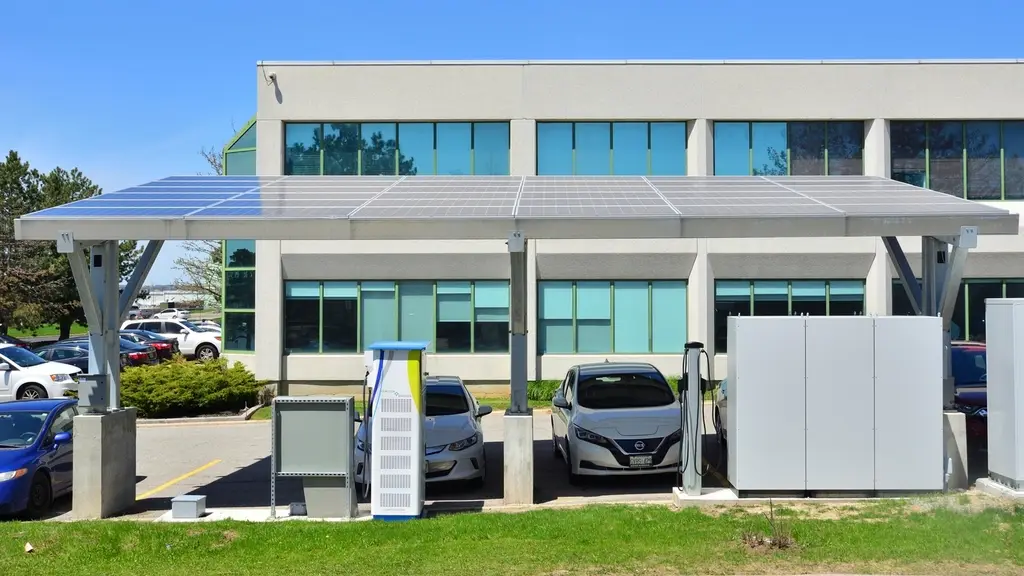 EV chargingHow to plan workplace and fleet EV charging with solar: supply capacity, load management, charger types, matching generation to charging and grant support.
- WarehousesLarge unshaded roofs and daytime shift work make many warehouses a strong fit for rooftop solar, provided the roof structure, rooflights and lease terms stack up.