
Key facts
| Network operator | Northern Powergrid (Yorkshire licence area) |
| Planning authority | Sheffield City Council; Rotherham Metropolitan Borough Council for the Advanced Manufacturing Park; Peak District National Park Authority for the city's western fringe |
| Clean air zone | Class C Clean Air Zone covering the inner ring road and city centre since February 2023 |
| Indicative yield | About 830 to 930 kWh per kWp a year for a well-oriented array |
| Nation support page | Grants and support in England |
Grid connection with Northern Powergrid
Sheffield is in Northern Powergrid's Yorkshire licence area. Commercial systems above the G98 limits need G99 approval before they connect. To the south, the city borders Derbyshire, which is served by a different operator, so sites near the boundary should confirm theirs with the Energy Networks Association postcode tool.
Heavy industry in the Lower Don Valley means some sites already have large high-voltage supplies, which can make connecting a big array simpler than on a small low-voltage supply. Others find export is restricted and use a G100 export limitation scheme. Our page on G99 and DNO applications explains the process and the information the installer needs from you.
Planning in Sheffield and Rotherham
Sheffield City Council is the planning authority for most of the city, including the Lower Don Valley, Meadowhall, Sheffield Business Park and the Olympic Legacy Park. The Advanced Manufacturing Park at Waverley, home to research facilities linked to the University of Sheffield, is just across the boundary in Rotherham, so Rotherham Metropolitan Borough Council decides applications there. The western edge of the city lies inside the Peak District National Park, where the national park authority handles planning and the rules are stricter.
England's permitted development rights for non-domestic rooftop solar were widened in December 2023, removing the previous 1 MW limit, with conditions on flat roof height, listed buildings and conservation areas. Kelham Island and other historic industrial quarters include listed works buildings, so check designations early.
The local economy and solar
Sheffield is known for steel, special metals and precision engineering, and the wider city region has built an advanced manufacturing cluster around the Advanced Manufacturing Park. Universities, health and a growing digital sector add large daytime loads. Engineering firms running machining, heat treatment or compressed air during the day are often strong candidates, because a high share of generation is used on site. See our page on factories for what the survey looks at.
The Clean Air Zone and vehicle charging
Sheffield's Clean Air Zone has charged since February 2023 and covers the A61 inner ring road and the city centre inside it. It is a Class C zone, so private cars and motorcycles are not charged, but non-compliant vans, taxis, buses, coaches and HGVs are. At the time of writing the published daily charges are £10 for vans and taxis and £50 for HGVs, buses and coaches; check the council's Clean Air Zone pages for current rates and exemptions.
For trades, delivery firms and manufacturers sending vans into the centre, electric vans avoid the charge and can be charged at the depot from a rooftop array during the day. Our EV charging for business page covers how charging and solar are planned together.
Roofs and buildings in Sheffield
- Victorian works and cutlery workshops in Kelham Island and Neepsend, with brick walls, slate pitches and sometimes north-light roofs. North-light roofs have their glazed faces pointing north, but the solid south-facing slopes can suit panels.
- Large post-war steel and engineering sheds in Attercliffe, Tinsley and Darnall, some with asbestos cement sheeting; see asbestos roofs.
- Modern units at Sheffield Business Park and the Advanced Manufacturing Park, with profiled metal roofs.
Sheffield's hills and valleys can cause shading from slopes and neighbouring buildings, especially in winter, so the shading assessment matters more here than on flat land.
Expected generation
A well-oriented array in Sheffield typically produces about 830 to 930 kWh per kWp a year (indicative). The European Commission's PVGIS model gives close to 945 kWh per kWp for an ideally angled south-facing array with standard losses, and nearer 760 for a low-pitch east-west layout.
How the free survey works in Sheffield
Use the short form to tell us about the site. We review the enquiry, call you to understand the building and your energy use, and if it looks suitable we arrange a free survey with one MCS certified installer matched to the site. Your details go to that installer only. The survey can be in person or virtual, and there is no obligation. See the Yorkshire and the Humber page for the wider region.
Frequently asked questions
Are private cars charged in Sheffield's Clean Air Zone?
No. Sheffield's zone is Class C, so private cars and motorcycles are not charged. Non-compliant vans, taxis, buses, coaches and HGVs are. If your business runs vans into the city centre, switching to electric avoids the charge, and charging those vans from your own solar during the day can lower running costs. Check current rates on the council's website.
Who handles planning at the Advanced Manufacturing Park?
Rotherham Metropolitan Borough Council, because the park at Waverley lies in Rotherham rather than Sheffield. Most rooftop systems on modern units there can use permitted development, subject to national conditions. Many units are leased, so landlord consent and any estate management rules usually need to be agreed before installation work begins.
Can solar go on a north-light factory roof?
Often, yes. North-light roofs have glazed slopes facing north and solid slopes facing roughly south, and the solid slopes can carry panels if the structure allows. The glazing must not be covered, and gutters between bays need safe access for maintenance. A structural survey confirms what loads the roof can take.
We already have a high-voltage supply. Does that help?
It can. Sites with their own high-voltage connection and transformer may be able to connect a large array without new low-voltage capacity, and export is assessed on the high-voltage network. The operator still needs a G99 application and may set export limits. The survey and installer review your existing supply arrangements and protection settings.
Related pages
- Yorkshire and the HumberNorthern Powergrid connections, Sheffield and Bradford clean air zones, Humber ports and industry, M62 and M1 logistics, and East Riding arable farming.
- LeedsNorthern Powergrid G99 approvals, planning across Leeds and neighbouring West Yorkshire councils, Aire Valley and M62 logistics roofs and listed mill buildings.
- NottinghamNGED East Midlands grid approvals, planning across Nottingham, Broxtowe and Rushcliffe, the Workplace Parking Levy and the city's lace warehouses and modern sheds.
- FactoriesFactories with heavy daytime process loads can use nearly all the solar they generate. The survey focuses on the electrical system, roof condition and how to install without stopping production.
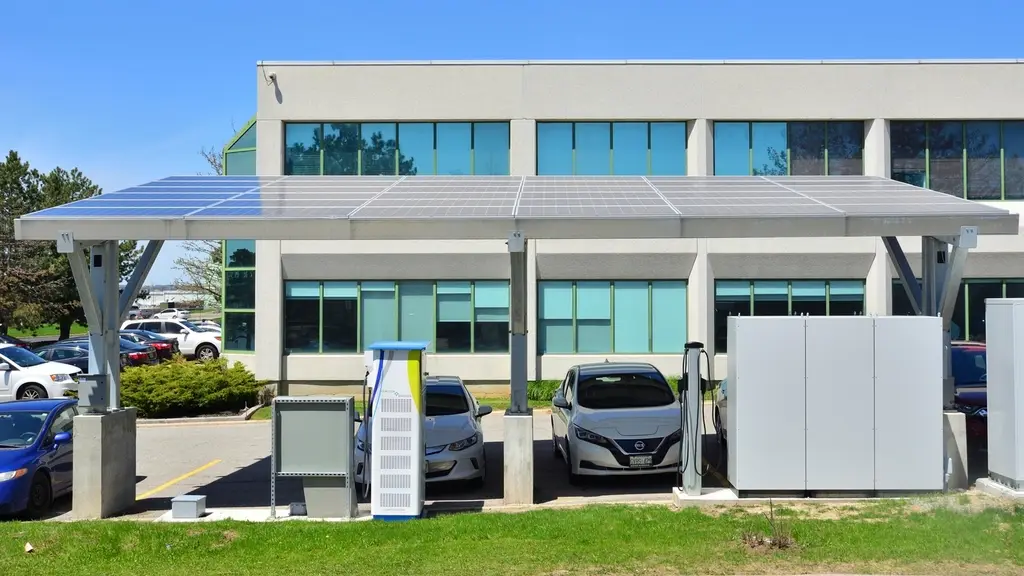 EV chargingHow to plan workplace and fleet EV charging with solar: supply capacity, load management, charger types, matching generation to charging and grant support.