
What a business EV chargepoint costs: the published figures
There is no official price list for chargepoints, but the government has published the costs it used when it made chargepoints compulsory in new non-residential buildings. They came from quotes gathered by the consultants Steer and were checked against grant data (DfT impact assessment, 24 September 2021). They are in 2019 prices, so treat them as a guide to the shape of the cost, not a quote.
One 7 kW smart chargepoint in a surface car park, DfT final impact assessment (2019 prices)
| Where | Low | High |
|---|---|---|
| Existing car park (retrofit) | £1,640 | £8,210 |
| New build car park | £1,182 | £6,463 |
| Central figure used by DfT | £3,823 | |
| Ducting for a future bay, existing car park | £167 a space | £2,500 a space |
| Ducting for a future bay, new build | £67 a space | £600 a space |
DfT priced every car park as a surface car park, the most expensive type, because trenching across tarmac is where the cost goes. It says "the cost of having to dig up roads is high" and that the gap between low and high comes from the distance between the power supply and the chargepoint.
What makes up the cost
The same assessment breaks the wiring and installation of a single chargepoint into parts. These exclude the charger unit itself.
Wiring and installation for one chargepoint in a surface car park (Steer, in the DfT assessment)
| Part | New build | Existing car park |
|---|---|---|
| Cabling and ducting | £500 to £1,500 | £500 to £1,500 |
| Electrical equipment | £80 to £360 | £80 to £360 |
| Civils (digging and making good) | £300 to £1,000 | £300 to £2,000 |
| Total | £880 to £2,860 | £880 to £3,860 |
Two further items can swamp everything else:
- The charger unit. DfT's figures are for a ground-mounted 7 kW smart charger. A wall-mounted unit on a building beside the bays avoids a pedestal and some of the trenching.
- The grid connection. DfT's low case assumes your supply has room and costs nothing extra. Its high case assumes the transformer has to be replaced. In between is a supply upgrade from your network operator, which is quoted site by site.
A second public source: Scottish case studies
Transport Scotland published worked costs for a ground-mounted 7 kW charger, from a 2022 evidence review (Transport Scotland case studies):
| Case | Materials | Installation | Network connection | Total per charger |
|---|---|---|---|---|
| New business park | £2,888 | £750 | £0 | £3,638 |
| Existing supermarket car park | £2,888 | £750 | £2,500 | £6,138 |
Its wider range, from installation cost data, was £2,044 to £11,569 a charger in urban areas and £1,273 to £7,255 in rural ones. Both sources agree on the point that matters: the connection and the groundworks, not the box on the post, decide whether a chargepoint costs closer to £2,000 or £8,000.
7 kW, 22 kW and rapid chargers
| Charger | Supply it needs | What drives the cost |
|---|---|---|
| 7 kW AC | Single phase is enough | Mostly trenching and cable length; the published figures above are for this type |
| 22 kW AC | Three phase | A bank of them quickly uses up spare supply capacity; many cars charge at 11 kW or less on AC, so check before paying for 22 kW |
| Rapid DC, 50 kW and above | Three phase, usually a larger supply | The connection: a rapid charger often needs a supply upgrade, which only your network operator can price |
We could not find a published government unit cost for 22 kW or rapid chargers that we could check, so we don't quote one. For rapid charging, ask for the network operator's connection quote before you compare installers' prices. Our page on grid connections and DNO applications explains how capacity is applied for.
Running costs
DfT's assessment used maintenance contracts of £237 to £360 a year per site, £324 in its central case. Add the electricity itself and any software or payment service if staff, visitors or the public pay to charge.
Grants and tax relief
Workplace Charging Scheme. Checked on GOV.UK on 9 November 2026: the grant pays up to 75% of the cost of buying and installing chargepoints, capped at £500 per socket for installations completed from 1 April 2026, for up to 40 sockets across your sites, until 31 March 2027 (GOV.UK). State-funded schools and colleges have their own version worth up to £2,000 a socket. The staff and fleets grant and the commercial landlord chargepoint grant stopped taking applications on 31 March 2026. For businesses, the chargepoints must be for staff or fleet parking, not customers (Find a grant). Our Workplace Charging Scheme guide covers who can apply, and EV charger grants for business adds the depot scheme for van fleets and what the deadline means for timing.
An illustrative example. Ten sockets costing £2,000 each including VAT, £20,000 in all. 75% of £2,000 is £1,500, above the cap, so the grant is £500 a socket: £5,000, leaving £15,000. The cap, not the 75%, is what limits most installations.
Capital allowances. Spending on electric vehicle chargepoints qualifies for a 100% first-year allowance, which has been extended to 31 March 2027 for Corporation Tax and 5 April 2027 for Income Tax (GOV.UK). Confirm how it applies to your business with your accountant.
When a chargepoint is compulsory. In England, new non-residential buildings and major renovations with more than 10 parking spaces need at least one chargepoint and cable routes for one in five spaces (Approved Document S). The Workplace Charging Scheme does not pay for chargepoints that are a legal or planning requirement.
Charging from your own solar panels
Staff cars sit in the car park through the middle of the day, which is when solar panels generate most. Power that would otherwise be exported for a few pence goes into the cars instead.
An illustrative example, using this site's shared figures. One car takes 28 kWh in a working day (4 hours at 7 kW). If that comes from your own panels rather than the grid, you avoid buying it at an illustrative 24p per kWh instead of exporting it at an illustrative 5p: about £5.32 a car a day. Real figures depend on your own unit rate and export tariff, and in winter far more of the charging will come from the grid.
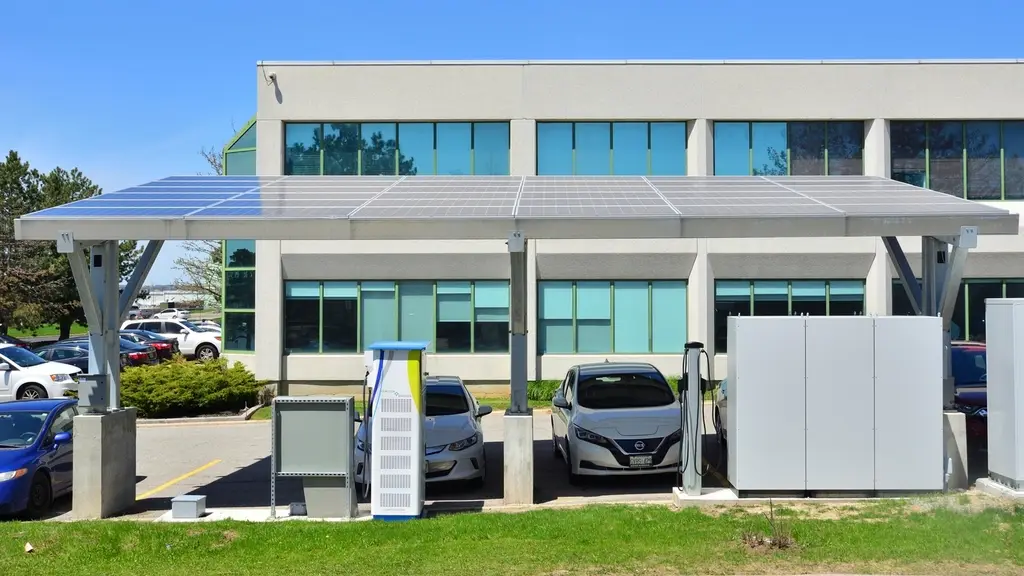
That is why it pays to plan chargers and panels together: the extra daytime demand raises the share of solar you use on site, which shortens the payback on the panels. Depot fleets that charge overnight need a battery to use solar at all. Covering the bays with a solar carport puts the panels and the chargers in one place. More on how the two work together: EV charging for business.
What to ask for in a quote
- The charger model, its power and whether it is "smart" (able to follow a schedule, solar output or a site limit)
- Whether your existing supply can take the chargers, with the load management setting used
- The trench length, surface reinstatement and ducting for future bays
- Any network operator work and who applies for it
- The Workplace Charging Scheme deduction, shown separately
- Maintenance, warranty and any back-office fees
If you are thinking about solar as well, mention the chargers when you request a free survey: the matched installer will model the charging with the panels and check your supply for both.
Sources
Read on 9 November 2026. The DfT figures are in 2019 prices and the Scottish figures date from a 2022 evidence review; installers' prices today will differ.
- DfT: Non-residential charging infrastructure provision, final impact assessment (24 September 2021)
- Transport Scotland: Electric vehicle charge points for new buildings, Appendix A case studies
- GOV.UK: Changes to electric vehicle chargepoint grant schemes from 1 April 2026
- GOV.UK Find a grant: Workplace Charging Scheme
- GOV.UK: Extension of first-year allowances for zero-emission cars and chargepoints
- GOV.UK: Approved Document S, infrastructure for the charging of electric vehicles
Frequently asked questions
How much does it cost to install an EV charging station at a business?
The Department for Transport's published figures put one 7 kW smart chargepoint in an existing surface car park at £1,640 to £8,210, with a central figure of £3,823, in 2019 prices. Transport Scotland's case studies came to £3,638 a charger with no network work and £6,138 with a £2,500 connection charge. Trenching and the supply decide where a site lands.
Is there a grant for business EV chargers in 2026?
Yes. The Workplace Charging Scheme pays up to 75% of the cost of buying and installing chargepoints, capped at £500 per socket for installations completed from 1 April 2026, for up to 40 sockets, and runs to 31 March 2027. For businesses the chargepoints must be for staff or fleet parking. Checked on GOV.UK on 9 November 2026.
Why do some chargepoint quotes cost so much more than others?
Mostly because of the ground and the supply. DfT found the biggest variation comes from civil works in surface car parks, where trenching is needed, and from the distance between the power supply and the chargers. If your supply has no spare capacity, a network upgrade can cost more than the chargers themselves. Ask each installer to show those items separately.
Can we claim capital allowances on EV chargepoints?
Spending on electric vehicle chargepoints qualifies for a 100% first-year allowance, extended to 31 March 2027 for Corporation Tax and 5 April 2027 for Income Tax. That lets a business deduct the full cost from profits in the year of purchase. Check the treatment for your own business, including how any grant affects the claim, with your accountant.
Does adding solar make workplace EV charging cheaper to run?
It can, when cars charge while the panels generate. Each kWh from your own panels replaces power you would buy at your full unit rate instead of power you would export for a few pence. Staff cars parked through the day fit well; fleets that charge overnight need a battery to benefit. Winter output is much lower, so the grid still covers a share.
Related pages
 EV chargingHow to plan workplace and fleet EV charging with solar: supply capacity, load management, charger types, matching generation to charging and grant support.
- Workplace Charging SchemeThe OZEV chargepoint grant for workplaces: £500 per socket, up to 40 sockets, who can apply, how the voucher works and the 31 March 2027 end date.
- Solar carportsSolar car park canopies: permitted development in England, foundations and drainage, structural design, EV charging and how costs compare with rooftop solar.
 Battery storageWhen a commercial battery pays: storing surplus solar, time of use tariffs, peak shaving, sizing from half-hourly data, illustrative costs, safety and siting.
- G99 and DNO applicationsG98 versus G99, what goes into a DNO application, connection offers, export limitation under G100, reinforcement costs and how the survey checks your supply.
 Capital allowancesHow solar panels are treated for capital allowances: the special rate pool, the Annual Investment Allowance, the 50% first year allowance for companies, and illustrative examples.