
The grant at a glance
| Is it open? | Yes. GOV.UK says "The grant is open" and funding is confirmed until 31 March 2027 |
| Closing date | 31 March 2027, 11:59pm. This is the final year: it "has been extended for a final year" |
| What it pays | Up to 75% of the cost of buying and installing chargepoints, including VAT |
| The cap | £500 per socket, for installations completed on or after 1 April 2026 |
| How many sockets | Up to 40, across all your sites |
| Most one organisation can get | £20,000 (40 sockets at £500 each) |
| Who can apply | Businesses, charities, public sector organisations and small accommodation businesses |
| Where | England, Wales, Scotland and Northern Ireland (not the Channel Islands or Isle of Man) |
| How you get it | A voucher, which your installer deducts from the invoice |
The scheme is the Workplace Charging Scheme, run by the Office for Zero Emission Vehicles (OZEV) with the DVLA. Source: GOV.UK Find a grant, read on 13 November 2026. For the full eligibility rules, see our Workplace Charging Scheme guide.
What it is worth: a worked example for 10 sockets
The grant is the lower of two figures: 75% of the total cost, or £500 for each socket. For 10 sockets the cap is 10 × £500 = £5,000. The 75% rule only reaches that cap once the job costs £6,667 or more (£5,000 ÷ 0.75), which is about £667 a socket.
The two job costs below are illustrative, to show how the rule works. They are not prices: your installer quotes the real figure.
Smaller job: 10 sockets costing £6,000 in total, including VAT (illustrative)
- 75% of £6,000 = £4,500
- Cap: 10 sockets × £500 = £5,000
- Grant, the lower of the two: £4,500
- What the business pays: £1,500
Larger job: 10 sockets costing £15,000 in total, including VAT (illustrative)
- 75% of £15,000 = £11,250
- Cap: 10 sockets × £500 = £5,000
- Grant, the lower of the two: £5,000
- What the business pays: £10,000
On the smaller job the 75% rule decides the grant, and the business pays a quarter of the cost. On the larger job the £500 cap decides it, so every pound above £6,667 is the business's own. Our EV charging installation cost page sets out the government's published costs per chargepoint, which are well above £667, so on many installations the cap is what counts.
Three more rules affect the figure:
- The completion date sets the rate. An installation completed on or after 1 April 2026 is worth up to £500 a socket. One completed before then was worth up to £350, "regardless of when they applied for a grant" (GOV.UK). Older articles quoting £350 describe that earlier rate.
- You can come back for more. Further vouchers are allowed while your running total stays within 40 sockets. GOV.UK's own example: "if 10 chargepoint sockets were initially claimed, you will be eligible for 30 further sockets."
- Only chargepoint costs count. Eligible costs are the unit, electrical components, civil works, installation labour, hardware, a site survey that leads to a completed installation, the VAT you pay, and a smart meter or current clamp fitted at the same time. Project management, admin, land, the electricity itself, ongoing data and operating costs, warranties beyond 3 years and anything not on the list are not (installer guidance).
Who can apply
The scheme is open to eligible businesses, charities, public sector organisations and small accommodation businesses. To show you are a business you need one of your Companies House reference number, a VAT registration number or a business rates bill. Charities, NHS surgeries and schools without these can upload other evidence.
- You need the site. You must own the property or have your landlord's consent for chargepoints at the sites in your application.
- You need dedicated parking. The site needs dedicated off-road parking clearly associated with the premises. The chargepoint bays must be designated to you, although the rest of the car park can be shared.
- Businesses: staff and fleet only. For a business, the chargepoints must be for staff or fleet, not customers, though you can let local residents use them outside office hours.
- Charities, public bodies and small accommodation businesses have no restriction on who uses the parking: customers, guests, visitors, staff or others.
- A subsidy limit. You can receive up to £315,000 of minimal financial assistance over 3 financial years. Public authorities do not need to make this declaration.
- You must be trading, and not insolvent or dissolved (terms and conditions).
What rules a site out
- Parking used only by customers, or not designated to you
- A car park that has not been built yet
- Chargepoints that are a legal or planning requirement, for example under building regulations for new buildings
- An address that has already claimed under the scheme or its predecessors
- Any chargepoint fitted before the voucher was issued. OZEV says you must apply "before you install any chargepoints"
How it works, step by step
- Get the site surveyed first. GOV.UK says "You should have your site surveyed by an installer before you apply for the grant."
- Apply online yourself through the Workplace Charging Scheme application service. The business fills in the form: installers "must not fill in the form on your behalf".
- Receive a voucher. If you are successful, a voucher code is emailed within 5 working days.
- Give the voucher to an OZEV-authorised installer. Only an authorised installer can claim the grant.
- The installer deducts the grant from your invoice. You pay the balance; the installer claims the grant from OZEV.
- The work must be finished and claimed within 180 days of the voucher being issued. If the job cannot be finished in time, you withdraw and apply again, and any work done before the new voucher is not eligible.
- Keep the chargepoints in place. If one is removed within 3 years you must tell the DVLA, and the grant may be reclaimed.
What the 31 March 2027 deadline means for you
A voucher lasts 180 days, but the scheme closes on 31 March 2027, and GOV.UK does not say what happens to a voucher that runs past that date. The government also reserves the right to end or change the scheme, and says it will aim to give 4 weeks' notice. The safe plan is to have the chargepoints fitted and the grant claimed before 31 March 2027, which means getting the survey done and applying soon rather than in the new year.
Schools and colleges: a larger grant
State-funded schools and other state-funded education institutions have their own version of the scheme, also open until 31 March 2027 (GOV.UK):
- 75% of the cost up to £2,000 per socket, for up to 40 sockets across all sites
- Applications made before 1 April 2026 keep vouchers worth up to £2,500 per socket
- Academy trusts can apply for up to 40 sockets for each institution in the trust
- The parking can be used by customers, guests, visitors, staff or others
Independent schools apply through the main Workplace Charging Scheme. More on solar for schools on our schools page.
The tax relief: a 100% first-year allowance
Separately from the grant, money spent on charge-point equipment qualifies for a 100% first-year allowance under section 45EA of the Capital Allowances Act 2001. The period runs to 31 March 2027 for businesses paying Corporation Tax and 5 April 2027 for those paying Income Tax (legislation.gov.uk). HMRC puts it simply: "If you buy it before April 2027, you can claim 100% first year allowances on ... equipment for electric vehicle charging points" (GOV.UK).
- The equipment must be new and unused, and "installed solely for the purpose of charging electric vehicles".
- You can claim it alongside the Annual Investment Allowance, as long as you do not claim both for the same cost.
- How the grant affects the amount you can claim is not set out in the sources we read, so ask your accountant to work out the net figure before you commit.
The deadlines for the grant and the allowance fall within days of each other, so one project finished before the end of March 2027 can use both. See our capital allowances guide for how solar panels are treated.
Vans, lorries and coaches: the Depot Charging Scheme
If you run a fleet from a depot, the Depot Charging Scheme is a separate and much larger grant (Find a grant):
- Open now: the application window runs from 11 November 2026 to 26 February 2027 (midday), with a £38 million budget
- What it pays: 60% of chargepoint and civil costs, up to £1 million across all sites
- Who: public and private fleets, local authorities and non-profits across the UK, with at least one battery electric van, HGV or coach now or planned, operating in the UK for at least a year, owning or leasing a UK depot, with enough grid capacity on site or a plan to upgrade
- How it is decided: one application per organisation per window, first come first served, or competitive if oversubscribed. Awards are aimed for 28 May 2027 and projects must be complete by 31 March 2028
Future windows are expected in the 2028/29 and 2029/30 financial years.
Scotland, Wales and Northern Ireland
The Workplace Charging Scheme covers all four nations. Beyond it:
- Scotland: Transport Scotland's 2026-27 package of incentive schemes includes Rural and Island Workplace Charging, aimed at microbusinesses and third sector organisations in rural and island communities, delivered by Energy Saving Trust alongside the UK schemes. Check the current terms with Transport Scotland and Energy Saving Trust before you plan around it.
- Wales: we found no separate Welsh Government chargepoint grant for businesses. Business Wales points businesses to the UK grant of up to £500 a charge point.
- Northern Ireland: the Department for Infrastructure lists the Workplace Charging Scheme at £500 per socket and 40 sockets, the education version and the Depot Charging Scheme (DfI).
See our grants in Scotland, Wales and Northern Ireland pages for solar support in each nation.
What has closed, and what is not for businesses
- The staff and fleets grant and the commercial landlord chargepoint grant closed to applications on 31 March 2026. If you read about them, they are no longer open.
- The LEVI Fund is for councils, not businesses. It supports Tier 1 local authorities in England with charging for residents who have no off-street parking (GOV.UK).
- Business rates relief for EV charging in England and Wales covers properties that are wholly or mainly a charging point and its bays, open to customers or the public and rated on their own. It will not normally help a staff car park inside your own premises.
What your business gets out of it
- Money off the invoice, not a claim to chase. The installer deducts the grant, so you pay the balance and never wait for a payment.
- Tax relief in the first year. New charger equipment bought before April 2027 can qualify for a 100% first-year allowance, so its cost can be set against profits in the year you buy it. Check the figure with your accountant.
- Charging for staff at work. Staff with electric cars can charge while they are at work. GOV.UK says employees "will not be taxed on the cost of electricity if certain conditions are met"; ask your accountant what those conditions are.
- Fleet vehicles charged on your own site, rather than at public chargers, with the Depot Charging Scheme for larger van and lorry fleets.
- Off-peak by default. In Great Britain, workplace chargepoints must be smart, and the grant requires it too: they come set to charge outside weekday peak hours (8am to 11am and 4pm to 10pm), and the owner can accept, remove or change those settings (Smart Charge Points Regulations).
One cost to know about: since 1 November 2026, electricity supplied through chargepoints that employees and contractors use at work is standard rated for VAT, unless supplied to a charity for non-business use (HMRC). If you charge staff for electricity, ask your accountant how that applies.
Solar and EV charging together
To be clear first: the Workplace Charging Scheme does not pay for solar panels. None of its guidance mentions solar, and panels are not on its list of eligible costs. Adding solar neither helps nor harms your grant application, so keep the solar and the charger costs in separate quotes, and make sure each one stands on its own sums.
What solar adds is cheaper charging. Staff cars are usually parked through the middle of the day, which is when solar panels generate most. Charging them from your own panels uses electricity you would otherwise export for a few pence, in place of electricity you buy at your full unit rate. Because the chargepoint owner can change the default charging hours, you can set the chargers to match when the panels generate. In winter far more of the charging will come from the grid.
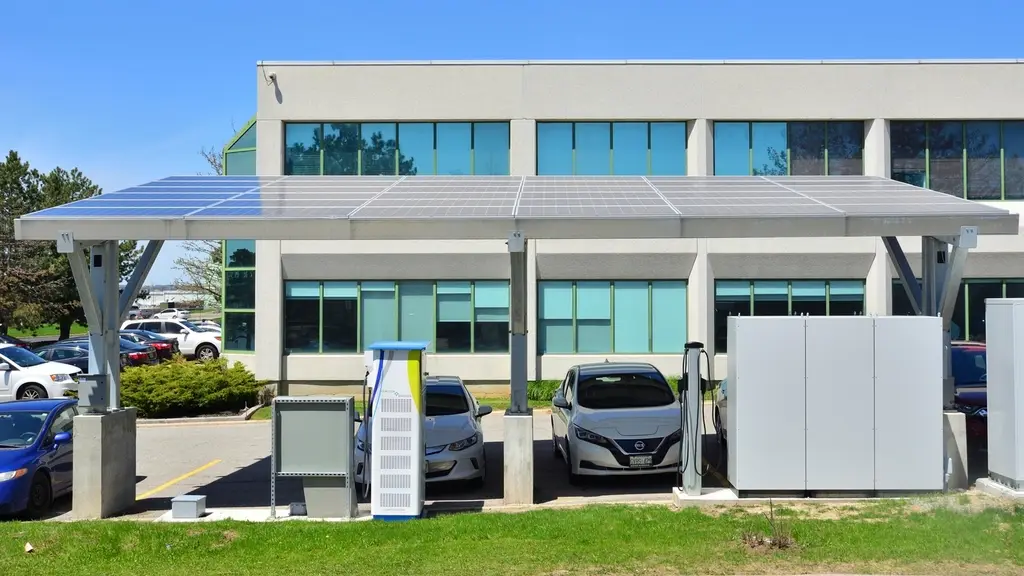
It also makes sense to look at both in one visit. The roof and the car park, the electricity supply and the switchboard all matter to both projects, and a site that can take panels and chargers together is worth knowing about before either is installed. Covering the bays with a solar carport puts panels and chargers in the same place. Read more on EV charging for business.
When you request a free survey, tell us you are planning chargepoints. The matched installer will look at the roof and the car park together and check your supply for both. The chargepoint survey for the grant must be by an OZEV-authorised installer: if the solar installer is not one, they will tell you what a chargepoint installer needs to know.
Before you sign anything
- Do not pay for or fit any chargepoint before your voucher is issued
- Check the installer is OZEV-authorised and the chargepoint model is on the approved commercial list
- Ask for the grant to be shown as a deduction on the quote and invoice
- Confirm the bays are designated to you and, for a business, used by staff or fleet
- Agree a timetable that finishes the work and the claim within 180 days and before 31 March 2027
- Ask your accountant how the grant and the 100% allowance work together for you
Sources
All read on 13 November 2026.
- GOV.UK Find a grant: Workplace Charging Scheme (open until 31 March 2027)
- GOV.UK: Workplace Charging Scheme guidance for installers (updated 1 April 2026)
- GOV.UK: Changes to electric vehicle chargepoint grant schemes from 1 April 2026 (updated 7 July 2026)
- GOV.UK: OZEV home and workplace grants terms and conditions
- GOV.UK: Workplace Charging Scheme for state-funded education institutions (updated 1 April 2026)
- legislation.gov.uk: Capital Allowances Act 2001, section 45EA
- GOV.UK: Claim capital allowances, first-year allowances
- GOV.UK Find a grant: Depot Charging Scheme (11 November 2026 to 26 February 2027)
- legislation.gov.uk: Electric Vehicles (Smart Charge Points) Regulations 2021, regulations 3 and 10
- HMRC Revenue and Customs Brief 13 (2026): VAT and Climate Change Levy on EV charging
- GOV.UK: Apply for Local EV Infrastructure (LEVI) funding
- Transport Scotland: Speeding up the transition to net zero (25 March 2026)
- Department for Infrastructure NI: EV chargepoint and infrastructure grants
Note: General information, not tax advice. Grant rules can change at short notice, so check GOV.UK before you apply.
Frequently asked questions
Is there a grant for EV chargers for businesses in 2026?
Yes. The Workplace Charging Scheme is open and pays up to 75% of the cost of buying and installing chargepoints, capped at £500 a socket, for up to 40 sockets across your sites. It is in its final year and closes on 31 March 2027. Businesses, charities, public sector organisations and small accommodation businesses across the UK can apply.
How much can a business get from the EV charger grant?
Up to £500 a socket or 75% of the cost, whichever is lower, for up to 40 sockets. That makes £20,000 the most one organisation can receive. For 10 sockets the most is £5,000, and you only reach it once the job costs £6,667 or more. Below that, the grant is 75% of the cost.
Can we use the grant for chargers our customers use?
Not if you are a business. A business's chargepoints must be for staff or fleet parking, although you can let local residents use them outside office hours. Charities, public sector organisations and small accommodation businesses have no restriction on who uses the parking, so their customers, guests and visitors can use the chargers.
Does the EV charger grant pay for solar panels?
No. The Workplace Charging Scheme covers chargepoint costs only, such as the unit, cabling, civil works and installation, and none of its guidance mentions solar. Solar can still make the chargers cheaper to run, because staff cars parked during the day can charge from your own panels. Price the two projects separately.
Is there a grant for charging electric vans and lorries?
Yes, the Depot Charging Scheme. Its application window runs from 11 November 2026 to 26 February 2027 and pays 60% of chargepoint and civil costs, up to £1 million across all sites, for fleets with at least one battery electric van, HGV or coach. One application is allowed per organisation per window, and projects must be complete by 31 March 2028.
Should we wait until next year to apply?
We would not. The scheme closes on 31 March 2027, and GOV.UK does not say what happens to a voucher that runs past that date, even though vouchers last 180 days. The 100% first-year allowance on charger equipment also ends in April 2027. Getting the site surveyed and applying now leaves time to finish and claim.
Related pages
- Workplace Charging SchemeThe OZEV chargepoint grant for workplaces: £500 per socket, up to 40 sockets, who can apply, how the voucher works and the 31 March 2027 end date.
 EV chargingHow to plan workplace and fleet EV charging with solar: supply capacity, load management, charger types, matching generation to charging and grant support.
- EV charging installation costPublished per chargepoint costs for workplace EV charging, what pushes the price up, the £500 a socket grant to March 2027, and why charging from your own solar changes the sums.
- Solar carportsSolar car park canopies: permitted development in England, foundations and drainage, structural design, EV charging and how costs compare with rooftop solar.
 Capital allowancesHow solar panels are treated for capital allowances: the special rate pool, the Annual Investment Allowance, the 50% first year allowance for companies, and illustrative examples.
 GrantsAn honest overview of funding for commercial solar across the UK: tax reliefs, rates exemptions, VAT, export payments, loans and the schemes run in each nation.