
Salix funding at a glance
Every Salix scheme for public buildings, whether it can pay for solar, and its status as Salix showed it on 18 November 2026:
| Scheme | Where | Grant or loan | Status | Solar? |
|---|---|---|---|---|
| Public Sector Decarbonisation Scheme | England | Grant | Closed to new applications; awarded Phase 4 projects run to 31 March 2028 | Only on a building getting PSDS-funded low carbon heating |
| Public Sector Low Carbon Skills Fund | England | Grant | Salix says "There is currently no funding" | No: it paid for advice and heat decarbonisation plans |
| Scottish Public Sector Energy Efficiency Loan Scheme | Scotland | Zero-interest loan | Open for 2026/27 | Salix announced its Great British Energy solar boost under this scheme |
| Scotland Recycling Fund | Scotland | Zero-interest loan, matched by the public body | Open for 2026/27 | Capital energy efficiency or carbon reduction projects, over 100 technologies: ask Salix about solar |
| Scotland's Solar Energy Efficiency Loan Scheme | Scotland | Loan | Delivering; applications closed | Solar only |
| The Wales Funding Programme | Wales | Loan | Open for applications | Yes, and £4 million of Great British Energy money in it is for solar PV and renewables |
Only public sector organisations can apply. Salix funding is not open to private businesses; if you run one, see solar grants for business in England.
Is PSDS still open?
No. The Public Sector Decarbonisation Scheme was the government's grant for cutting carbon in public sector buildings in England, delivered by Salix Finance. GOV.UK's scheme collection records four phases (GOV.UK):
| Phase | Funding | Status (9 November 2026) |
|---|---|---|
| Phase 1 | £1 billion across 2020-21 and 2021-22 | Closed |
| Phase 2 | £75 million for 2021-22 | Closed |
| Phase 3 (3a, 3b, 3c) | Over £1.425 billion across 2022-23 to 2025-26 | Closed; the last window shut in November 2023 |
| Phase 4 | Financial years 2025-26 to 2027-28 | Closed to new applications in November 2024; awarded projects delivering |
On 12 June 2025, after the Spending Review, Salix told its mailing list that the government would "commit no further investment for the Public Sector Decarbonisation Scheme beyond currently awarded projects" (Salix bulletin). The same bulletin said every awarded project remains fully funded, that more than £1 billion of PSDS budget will still be invested up to 2028, and that Phase 4 grant funding runs until 31 March 2028. Salix's report on Phase 4, published on 8 December 2025, says 245 projects at 207 public sector organisations were approved, with more than £816 million allocated, and repeats that no further phases are planned (Salix).
If you already hold a Phase 4 grant
Solar can be part of it, but only in one situation. Salix's Phase 4 criteria list solar panels as an energy efficiency measure that is "only eligible" if installed "in a building served by a Public Sector Decarbonisation Scheme-funded low carbon heating source" (Salix). In practice that means panels on a building that is getting a heat pump or heat network connection through the same project, where the solar reduces that building's electricity demand. Talk to your Salix contact before changing the scope of an awarded project.
If you were waiting for Phase 5
There is no Phase 5 to wait for. If solar on your estate makes sense on its own numbers, the routes below are the ones open now.
What Salix funds now
Salix also runs loan schemes for the devolved governments. Statuses as Salix published them on 18 November 2026:
| Nation | Scheme | Status | What it offers |
|---|---|---|---|
| Scotland | Scottish Public Sector Energy Efficiency Loan Scheme | Open for applications for 2026/27 | Zero-interest loans for the Scottish public sector, up to 75% of the project value, payback of up to 12 years on new loan agreements |
| Scotland | Scotland Recycling Fund | Open for loan applications for 2026/27 | A ring-fenced fund held by the public body: Scottish Government capital through Salix, matched equally by the body, lent at 0% with up to a 12 year payback; the savings are reinvested in further projects year on year |
| Scotland | Scotland's Solar Energy Efficiency Loan Scheme | In delivery; applications closed | £2 million for solar PV, provided to the Scottish Government by Great British Energy |
| Wales | The Wales Funding Programme | Open for applications | Loans for energy efficiency and decarbonisation, for public sector bodies registered in Wales |
| Wales | Wales Funding Programme: Great British Energy | Delivering | An additional £9 million package, of which Salix runs £4 million through the Wales Funding Programme as loans for solar PV and renewables in public buildings. Renewable projects are funded from it only if they complete, with the spend incurred, by 30 November 2026; later projects can still apply to the wider programme |
| Wales | Digarbon (tertiary education) | Round 3 closed; earlier rounds delivering | Decarbonisation funding for colleges and universities in Wales |
A loan has to be repaid, usually from the savings the project makes, so it suits solar well: a well sized array on a building used in daylight produces a saving every year. Our payback guide shows how that saving is worked out, and a survey gives you the figures for your own building to put in a loan application.
A Salix loan for solar: a worked example
An illustrative project in Scotland, using the figures from our payback guide: a 100 kWp roof system at about £900 per kWp, generating about 90,000 kWh a year, 80% used on site at an illustrative 24p per kWh and the rest exported at 5p. Your own unit rate and usage will differ.
| Item | Figure |
|---|---|
| Project cost | About £90,000 |
| Largest Salix loan (up to 75% of the compliant project value) | About £67,500, at 0% interest |
| Paid from your own capital | About £22,500 |
| Saving a year | About £18,180 |
| Simple payback on the whole project | About 5 years |
| Salix's limit for new Scottish loans | Up to a 12 year payback, at £305 per tonne of CO2 |
A solar project with a payback like this sits well inside the limit, which is why loans suit solar: the saving each year is what repays the loan. Salix checks each project's figures itself, so the payback and carbon saving in your application need to come from a proper assessment of the building.
Who can get Salix funding
Salix says "only public sector organisations are eligible to apply", and each scheme sets its own list. The Scotland Recycling Fund, for example, names local authorities, local authority arm's-length external organisations (ALEOs) and universities; the Wales Funding Programme is for "public sector bodies registered in Wales". Salix says it works with hospitals, universities, local authorities, emergency services, schools and academies as well as central government departments; check the scheme page for your type of organisation before you plan around it.
How to apply for Salix funding
- Check the scheme page says "Open for applications" for your nation: Scotland or Wales. In England there is no open Salix scheme for solar at the moment.
- Get the evidence together: 12 months of half-hourly data, the roof's condition and an estimate of the system size, generation and saving.
- Confirm the grid connection: most public building systems need G99 approval from the network operator.
- Contact the Salix team for your nation and submit the application with the costed project.
- Plan for the deadline: in Wales the Great British Energy solar money needs the work finished, and paid for, by 30 November 2026.
In England, Salix's current role on solar is delivering the PSDS projects already awarded. Check Salix's scheme pages for any new scheme before you plan around one.
Great British Energy solar for schools and hospitals
Great British Energy (GBE), the publicly owned energy company, is now the main source of public money for rooftop solar on public buildings in England.
- 21 March 2025: about £80 million for rooftop solar on around 200 schools and £100 million for nearly 200 NHS sites in England. The government selected the schools, mainly in areas of deprivation in the North East, West Midlands and North West; for hospitals, the NHS ran an expression of interest process and manages the installations. The same announcement gave over £9.3 million to the devolved governments for renewables on public buildings or community projects: £4.85 million to Scotland, £2.88 million to Wales and £1.62 million to Northern Ireland (GOV.UK).
- 1 October 2025: the scheme grew to up to £255 million, covering around 250 schools, over 270 NHS sites and around 15 military sites (GOV.UK).
- 5 February 2026: £74 million for clean energy upgrades at 82 NHS trusts, 8 military sites and 1 prison, with £9 million delivered in partnership with GBE for battery storage and solar (GOV.UK).
- 16 July 2026: 245 schools and colleges had government-funded solar, and 100 more would join the Great British Energy Solar Partnership with up to £40 million. A pilot for 150 schools and colleges in Yorkshire and the Humber, the East Midlands and the South East will have private investors fund, install, own and maintain the panels, with the school paying nothing upfront and buying the electricity below its normal tariff. The pilot will inform a national rollout from 2027 to 2028 (GOV.UK).
None of these announcements describes an open application for an individual school or trust. If your school is in one of the pilot regions, ask your local authority or trust whether it is involved. The pilot is a power purchase agreement in all but name; our guide to power purchase agreements explains what to check in one, and solar for schools covers the school side of a project.
For councils working with a local community energy group, GBE also runs a Partnerships Grant in England; see our community energy guide.
Buying solar through a public sector framework
Most public bodies buy solar through a framework rather than running a full tender of their own. Two that cover solar PV, as their owners describe them:
| Framework | Owner | What it covers | Dates | How you buy |
|---|---|---|---|---|
| Decarbonisation of Estates (SBS10504) | NHS Shared Business Services | PV systems alongside other decarbonisation measures; open to UK public sector bodies including NHS organisations, councils, universities and schools | 13 January 2025 to 12 January 2029 | Further competition or direct award |
| Renewable Energy Solutions (2838_23) | ESPO | Lot 1 is solar PV, from small roof-mounted to large ground-mounted systems, from MCS accredited suppliers | 10 October 2023 to 9 October 2027, including its extension | Further competition |
A framework saves you running your own procurement, but it does not design the system for you. You still need to know how much of your building's electricity solar could replace, whether the roof can take it and what the network operator will allow. That evidence helps you write a specification for a further competition and judge the bids you get back.
Note: Your procurement team decides which route your organisation can use. Check each framework's current terms with its owner before you start.
What to do before any funding round
Funding windows are short, and most ask for a costed project. Getting these ready now means you can move when a round opens, or go ahead without one.
- Pull 12 months of half-hourly data for each building you are considering. It shows how much power you use in daylight, which decides the size of the system. Our energy data analysis page explains what to ask your supplier for.
- Check the roof. Age, covering, structure and any asbestos all matter. See the roof survey and structural survey pages.
- Find out about the grid connection. Most public building systems need G99 approval from the network operator. See G99 and DNO applications.
- Decide how you will pay: capital budget, a Salix loan where one is open, or a power purchase agreement. Our PPA or buy outright guide compares them.
- Get a feasibility study you can attach to a bid or a business case. A free site survey through us covers the building, the likely size and the saving.
We match public bodies with one MCS certified installer who passes our checks, in the same way as businesses. If your organisation must buy through a framework, tell us when we call and we will say whether the survey can still help you build the case.
Sources
Read on 9 November 2026; the Salix scheme pages were read again on 18 November 2026. Schemes open and close quickly, so check each source before relying on it.
- GOV.UK (DESNZ): Public Sector Decarbonisation Scheme collection
- Salix Finance bulletin: Public Sector Decarbonisation Scheme (12 June 2025)
- Salix Finance: progress on the final round of PSDS (8 December 2025)
- Salix Finance: Phase 4 PSDS project criteria
- Salix Finance: Scottish Public Sector Energy Efficiency Loan Scheme
- Salix Finance: Scotland Recycling Fund
- Salix Finance: Public Sector Low Carbon Skills Fund
- Salix Finance: Scotland's Solar Energy Efficiency Loan Scheme
- Salix Finance: funding schemes in Wales
- Salix Finance: Wales Funding Programme, Great British Energy
- GOV.UK: Great British Energy to cut bills for hospitals and schools (21 March 2025)
- GOV.UK: Great British Energy to extend solar scheme to military sites (1 October 2025)
- GOV.UK: Clean energy upgrades for hospitals and military sites (5 February 2026)
- GOV.UK (DfE): Hundreds more schools to save on bills (16 July 2026)
- NHS Shared Business Services: Decarbonisation of Estates framework (SBS10504)
- ESPO: Renewable Energy Solutions (2838_23)
Frequently asked questions
Is the Public Sector Decarbonisation Scheme still open?
No. Phase 4 closed to new applications in November 2024, and after the June 2025 Spending Review Salix said the government would commit no further investment beyond projects already awarded. Awarded projects remain fully funded, and Phase 4 grant funding runs until 31 March 2028. No further phases are planned.
What is Salix funding?
Government money for cutting energy use and carbon in public buildings, delivered by Salix Finance. In England it ran the Public Sector Decarbonisation Scheme, a grant now closed to new money. In Scotland and Wales it is mainly zero-interest loans repaid from the savings. On 18 November 2026 the Scottish Public Sector Energy Efficiency Loan Scheme, the Scotland Recycling Fund and the Wales Funding Programme were open for applications.
Who can apply for Salix funding?
Only public sector organisations. Each scheme has its own list: the Scotland Recycling Fund names local authorities, their arm's-length external organisations and universities, and the Wales Funding Programme is for public sector bodies registered in Wales. Private businesses cannot apply. A business looking for help with solar should look at tax relief, business rates and local schemes instead.
Does PSDS Phase 4 pay for solar panels?
Only in a building served by a low carbon heating source funded by the scheme. Salix's Phase 4 criteria treat solar panels as an energy efficiency measure that is eligible only on that condition, so solar usually appears alongside a heat pump or heat network project rather than on its own.
Can our school apply for Great British Energy solar panels?
Not through an open application that we could find. The schools in the first round were selected by government, mainly in areas of deprivation, and the July 2026 announcement added 100 more schools and a private investor pilot for 150 schools and colleges in Yorkshire and the Humber, the East Midlands and the South East. Ask your local authority or trust whether your school is included.
How can a council or NHS trust buy solar without PSDS?
By paying from capital budgets, borrowing through a Salix loan where one is open, or using a power purchase agreement where a funder owns the panels. The purchase itself usually goes through a framework such as NHS Shared Business Services' Decarbonisation of Estates (SBS10504) or ESPO's Renewable Energy Solutions (2838_23). A feasibility study helps with the specification either way.
Related pages
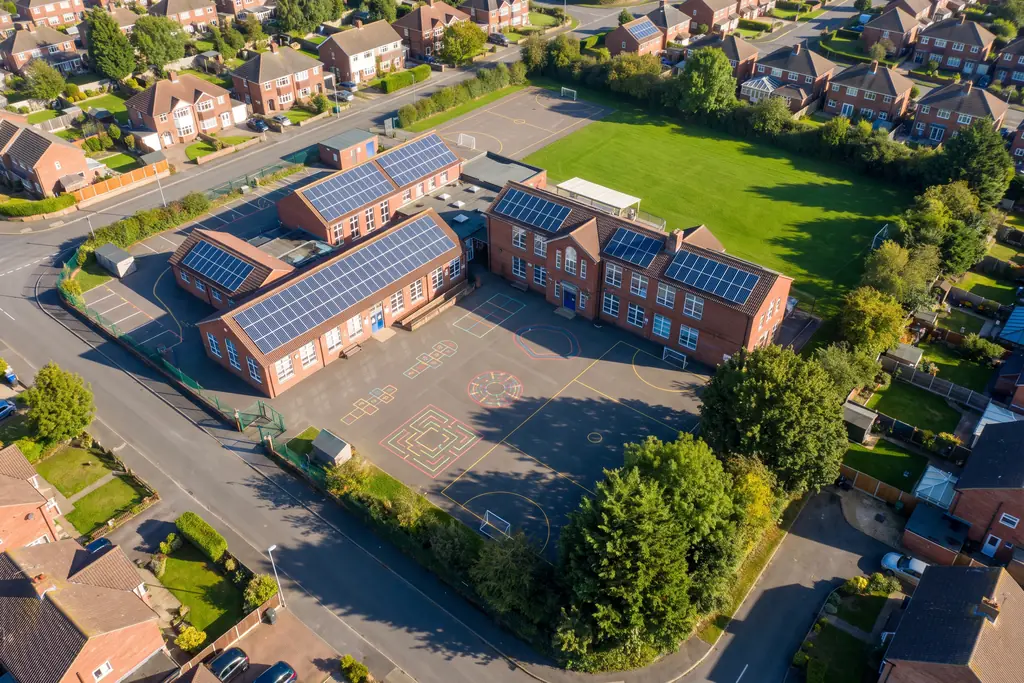 SchoolsSchools, academies and colleges have daytime demand but long summer closures. The survey models term-time use against holiday export and flags building and approval issues early.
- HealthcareContinuous demand in care homes and daytime clinical loads in surgeries and clinics suit solar. The survey focuses on backup power, fire strategy, occupied buildings and lease arrangements.
- EnglandCurrent solar support in England for businesses, schools, public bodies, community groups and farms, plus rates, planning and who to contact.
- ScotlandCurrent solar support in Scotland for businesses, community groups, public bodies, schools and farms, with rates, planning and official contacts.
- WalesCurrent solar support in Wales for businesses, farms, public bodies and community groups, with rates, planning and official contacts.
- Community energyCommunity energy schemes explained: the ways an organisation can host or join one, the GBE Community Fund, the Local Power Plan, CARES in Scotland and what to agree.