
The short answer
Start with your electricity use, not your roof. Size the system so that most of what it generates is used on site during daylight hours, because a kWh you use saves your full unit rate while a kWh you export earns a much lower export price. Then check two limits: how much usable roof you have (typically roughly 5 to 6.5 square metres per kWp, depending on the panels and layout) and how much your grid connection can accept.
If the roof could hold more than you can use, consider whether batteries, EV charging or heat pumps will soak up the extra in future, and whether the network will allow export. A survey models all of this against your half-hourly data.
Start with what you use
Annual consumption
Add up the kWh on your last 12 months of bills for every meter that the system could serve. This gives the ceiling: a system generating far more than your annual use will export a large share, however it is designed.
A typical UK rooftop array produces roughly 800 to 1,050 kWh per kWp per year, so as a first approximation every 1 kWp of panels generates around 1,000 kWh a year, a little less in the north and on east-west flat roof layouts.
The half-hourly profile
Annual totals hide the most important detail: when you use electricity. Solar generation follows the sun, peaking around midday and in summer, and falling to nothing at night. Half-hourly data shows how closely your demand matches that shape. The things to look for are:
- Daytime baseload: the lowest level your demand falls to during daylight, such as refrigeration, compressed air, servers or ventilation. Generation below this line is almost always used on site.
- Weekday and weekend: a site that closes at weekends loses most of the value of two days in seven unless it can store or export.
- Shift patterns: a site running two shifts uses more of the afternoon generation than one that finishes at lunchtime.
- Seasons: summer generation is several times higher than winter generation, so summer demand matters most for sizing.
- Holidays: schools and some seasonal businesses have their lowest demand in the sunniest weeks.
Our page on energy data analysis explains how designers overlay a generation curve on your profile.
How demand patterns tend to fit solar
These are general patterns, not rules. Your own data decides.
| Demand pattern | Fit with solar | What to watch |
|---|---|---|
| Steady daytime load seven days a week, such as cold storage | Usually strong | Roof structure under heavy plant |
| Weekday daytime offices | Good on weekdays | Weekend generation exported or stored |
| Shift-based manufacturing | Often strong | Shutdown weeks in summer |
| Schools and academies | Good in term time | Summer holidays fall in peak generation |
| Farms with milking or drying | Mixed | Early morning and evening peaks suit batteries |
| Hospitality with evening peaks | Moderate | Batteries can shift midday generation |
Our sectors pages discuss the details for each type of organisation.
How much can physically fit
As a typical rule of thumb, a commercial roof needs roughly 5 to 6.5 square metres of usable area per kWp, depending on the panel size and efficiency and the layout. Usable area is always less than the gross roof area. Deduct:
- edge zones kept clear for wind loading and safe access
- rooflights, vents, plant and parapets
- walkways and fire access routes, often following RC62 recommendations
- areas shaded by taller buildings, plant or trees
- weak or fragile areas the structural survey rules out
| Usable roof area | Typical system size (roughly 5 to 6.5 m² per kWp) | Typical annual generation (800 to 1,050 kWh per kWp) |
|---|---|---|
| 200 m² | about 30 to 40 kWp | about 24,000 to 42,000 kWh |
| 500 m² | about 75 to 100 kWp | about 60,000 to 105,000 kWh |
| 1,000 m² | about 150 to 200 kWp | about 120,000 to 210,000 kWh |
| 2,500 m² | about 385 to 500 kWp | about 308,000 to 525,000 kWh |
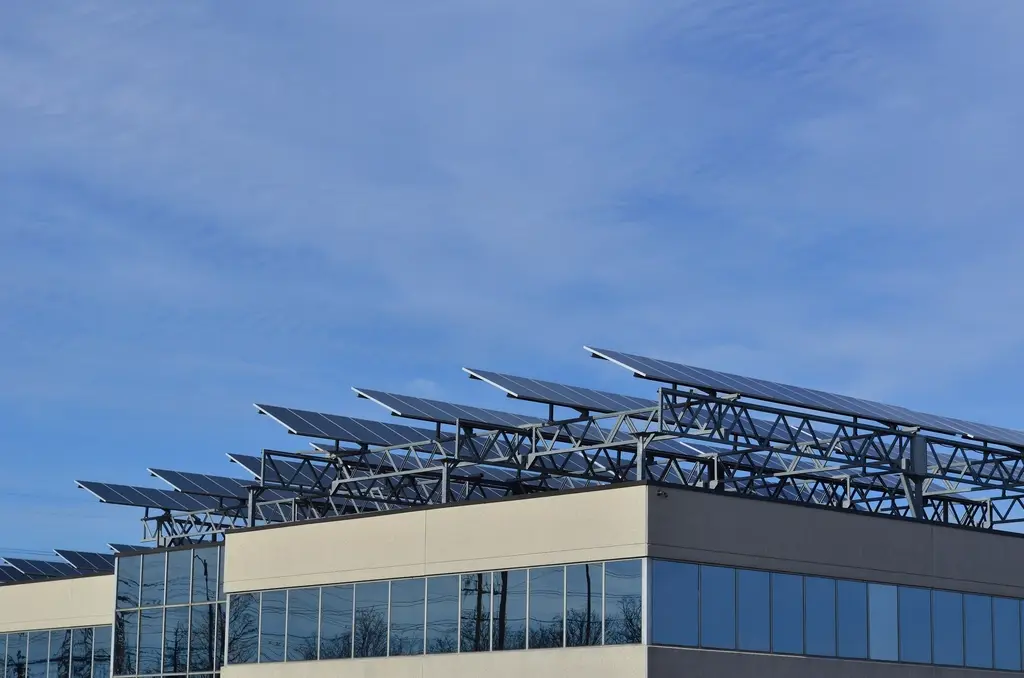
These ranges are illustrative. On flat roofs, an east-west layout fits more panels than a south-facing tilted layout because the rows do not shade each other, but each panel produces less. A roof survey confirms the real usable area and the weight the structure can carry, and our flat roofs page explains the layout trade-offs.
Self-consumption versus export
Two measures are easy to confuse:
- Self-consumption is the share of the solar generation you use on site. Higher is better for payback.
- Solar fraction (sometimes called self-sufficiency) is the share of your total demand that solar meets.
As a system gets bigger, solar fraction rises but self-consumption falls, because more of the midday and summer generation exceeds what the site needs. The financial sweet spot is usually where self-consumption stays high while the system is still large enough to make a meaningful dent in the bill.
The value gap is large. Using our illustrative figures, each kWh used on site saves 24p, while each kWh exported earns 5p. Your own unit rate and the export tariff you secure will differ. Export income in Great Britain comes through the Smart Export Guarantee, with rates and terms set by each supplier.
Grid limits
Every grid-connected system needs the network operator's agreement. Small systems up to 16A per phase (about 11.04 kW on a three-phase supply) can connect under G98. Anything larger needs G99 approval before connection. If the network cannot accept full export, G100 export limitation can let a larger system connect, with the inverters holding export below an agreed level.
This means the grid can cap the size that makes sense. If export is limited, generation above your on-site demand is curtailed and wasted unless you store it. Your own supply capacity also matters, especially on older sites. Read more about G99 and DNO applications.
Batteries
A battery stores midday surplus and releases it later in the day. It helps most where:
- the site has strong morning or evening demand but a gap in the middle of the day
- weekend generation would otherwise be exported cheaply
- export is limited by the network
- the business wants to shift grid imports away from expensive time bands
Batteries add cost, about £400 to £900 per kWh of usable capacity installed (illustrative), so they need their own business case. They are often added later once real generation data is available, provided the original design leaves room. See battery storage for business.
Plan for future loads
A system sized only for today's use may be too small in a few years. Think about:
- EV charging. Fleet vehicles charged during the day are an ideal use for solar, and workplace charging adds daytime demand. See EV charging for business.
- Heat pumps. These add demand mainly in winter, when solar output is lowest, so they increase annual consumption more than they improve the fit with solar.
- Electrified processes. Replacing gas ovens, boilers or forklifts with electric versions raises daytime demand.
- Expansion. New buildings, shifts or machinery.
If growth is likely, ask the installer to design for expansion: inverter capacity with headroom, cable routes sized for later additions, and roof areas kept clear for a second phase. A G99 application can sometimes be made for the final size even if you install in stages.
A worked illustrative example
This example uses illustrative figures only, with the assumptions stated. Real results depend on the site, and the survey models them.
The site: an illustrative light manufacturing unit using 300,000 kWh of electricity a year, working a double shift on weekdays with a modest weekend baseload.
The system: 100 kWp of panels on the main roof. At the typical 5 to 6.5 square metres per kWp, that needs roughly 500 to 650 square metres of usable roof.
Generation: at an illustrative 900 kWh per kWp, the system generates about 90,000 kWh a year, roughly 30% of the site's annual use.
Self-consumption: with a double shift, assume 80% is used on site (72,000 kWh) and 20% exported (18,000 kWh). That means solar meets about 24% of total demand.
Value each year:
| Item | Calculation | Illustrative value |
|---|---|---|
| Used on site | 72,000 kWh at 24p | £17,280 |
| Exported | 18,000 kWh at 5p | £900 |
| Total before maintenance | about £18,180 |
Cost and payback: at an illustrative £900 per kWp, the system costs about £90,000 excluding VAT, giving a simple payback of roughly 5 years before tax relief. Capital allowances can improve this; confirm the treatment with your accountant.
What if they went bigger? If the roof could take 200 kWp, generation would roughly double, but more of the extra output would arrive at midday, at weekends and in summer, when the site cannot use it. Self-consumption would fall, more would be exported at the lower rate, and the payback on the second 100 kWp would be longer than on the first. The installed cost per kWp would usually be lower, which partly offsets this. Whether the larger system makes sense depends on the half-hourly data, the export price, whether a battery is added, and whether demand is expected to grow. For the payback sums in more detail, see our solar payback guide.
A step-by-step sizing method
- Collect 12 months of bills and half-hourly data.
- Find your daytime baseload and your typical weekday and weekend daytime demand.
- Estimate the usable roof area and convert it to a maximum kWp.
- Check your supply capacity and likely network constraints.
- Model generation for a range of system sizes against your profile.
- For each size, calculate self-consumption, export and the value of each.
- Add future loads you are confident about.
- Consider whether a battery improves the result at the larger sizes.
- Choose the size that best meets your objectives, whether that is the fastest payback, the largest carbon reduction or the best long-term saving.
Common sizing mistakes
- Filling the roof because it is there, without checking how much will be exported.
- Sizing from annual totals without looking at when electricity is used.
- Forgetting weekend closures and holiday shutdowns.
- Assuming full export is available without checking with the network operator.
- Ignoring planned changes, such as EV fleets, that could justify a larger system.
Frequently asked questions
Should we size solar to cover all of our electricity use?
Usually not. Generating as many kWh a year as you use sounds sensible, but much of that generation would arrive at midday, at weekends and in summer when you cannot use it, so it would be exported at a much lower value. Most commercial systems are sized so that a high share of generation is used on site, which typically means solar meets only part of total annual demand.
How much roof do we need for a 100 kWp system?
As a typical rule of thumb, roughly 500 to 650 square metres of usable roof, based on about 5 to 6.5 square metres per kWp. The real figure depends on the panels, layout, edge zones, rooflights, plant and access routes. East-west layouts on flat roofs fit more panels into the same space. A roof survey confirms the usable area and whether the structure can carry the load.
Is it worth adding a battery?
It depends on your profile. A battery helps when you have demand in the early morning or evening, weekend generation that would otherwise be exported, or a network export limit. It adds an illustrative £400 to £900 per kWh of usable capacity installed, so it needs its own business case. Many sites install solar first and add a battery once real generation data is available.
Our site is closed at weekends. Is solar still worthwhile?
It can be. Weekend generation will mostly be exported or stored, so the system may be sized a little smaller to keep weekday self-consumption high. Exported electricity still earns income through an export tariff in Great Britain, and a battery may store some weekend surplus for Monday morning. Half-hourly data lets the installer model the effect of weekend closures precisely.
Can we start small and add more panels later?
Yes, if it is planned. Ask for a design that leaves inverter headroom, sizes cable routes for later additions and keeps roof space clear for a second phase. Network approval is the main constraint, because an extension may need a new G99 application. Applying for the final size at the start, where the network operator allows it, can make a phased project simpler.
Related pages
- Energy data analysisHow half-hourly consumption data shapes solar sizing and payback: getting the data, profile classes, baseload, weekend and seasonal use, self-consumption and batteries.
- Feasibility studyWhat a solar feasibility study covers, desktop versus on-site assessment, and the outputs a decision maker needs: size, yield, savings, payback, grid and risks.
 Battery storageWhen a commercial battery pays: storing surplus solar, time of use tariffs, peak shaving, sizing from half-hourly data, illustrative costs, safety and siting.
 Solar paybackA worked payback example for a 100 kWp system, the factors that move the result most, the effect of tax relief, and a calculator to try your own figures.
- G99 and DNO applicationsG98 versus G99, what goes into a DNO application, connection offers, export limitation under G100, reinforcement costs and how the survey checks your supply.
- Survey checklistA practical checklist of the energy data, drawings, consents and decisions to gather before a commercial solar survey, plus what to expect on the day and after.
- Solar output and exportOutput per kWp varies by place, roof and season; the share used on site, not the total, drives the savings.
- System sizesRoof area, output, cost and the rules that change by size, from MCS at 50 kW to grid and planning thresholds.