
The short answer
- Rooftop solar is usually the easy route. In England, permitted development for non-domestic rooftop solar applies on protected land since December 2023, with the same limits as elsewhere, except that panels cannot go on a wall fronting a highway.
- Ground-mounted arrays need planning permission and face the toughest test. National policy says development in these areas should be limited in scale and sensitively located, and major development should be refused other than in exceptional circumstances.
- The national park authority is the planning authority inside a national park, not the district council.
- Design is what decides most cases: low visibility, dark frames and mounting, roof slopes that face away from viewpoints, and arrays that follow field patterns and hedgerows.
Note: This guide is general information, not planning advice. Rules differ between England, Scotland, Wales and Northern Ireland, and each authority has its own local plan. Speak to the planning authority before committing to a design.
Which designations count
| Designation | Where | Planning authority |
|---|---|---|
| National parks | 10 in England plus the Broads, 3 in Wales, 2 in Scotland | The national park authority (in Scotland, the Cairngorms authority shares planning with the councils) |
| National Landscapes (formerly Areas of Outstanding Natural Beauty) | 38 across England and Wales, covering about 15% of England's land (National Landscapes Association) | The district or unitary council |
| Areas of Outstanding Natural Beauty | 8 in Northern Ireland | The district council |
| National Scenic Areas | 40 in Scotland | The council |
In England the National Planning Policy Framework groups national parks, the Broads and National Landscapes together as Protected Landscapes. Since December 2023, public bodies in England, including planning authorities, must seek to further the purposes of these areas when their decisions affect them, a stronger duty than the old one to "have regard" to them (Levelling-up and Regeneration Act 2023, section 245).
What national policy says in England
The current NPPF pulls in two directions, and a scheme has to satisfy both:
- Policy W3 says decision makers should give substantial weight to the benefits of renewable energy for energy security, the economy and net zero, and that applicants should not have to prove the need for it (chapter 10).
- Policy N4 says development in Protected Landscapes should be limited in scale and extent and sensitively located and designed, gives substantial weight to conserving their natural beauty, and says major development should be refused other than in exceptional circumstances and where it is in the public interest (chapter 19). Development in the setting of a Protected Landscape should also avoid or minimise harm to it.
Whether a scheme is "major development" here is a judgement for the decision maker, based on its nature, scale and setting and whether it could significantly harm what the area is designated for. A rooftop array on a farm shed is very unlikely to be; a field-scale array may well be.
Rooftop solar on protected land
In England, rooftop solar on non-domestic buildings in national parks, National Landscapes and conservation areas can use permitted development, subject to the general limits: no more than 0.2 metres proud of a pitched roof, no more than 1 metre above a flat roof, and at least 1 metre from the roof edge. Panels still cannot go on a wall fronting a highway, and systems above 50 kW need a prior approval application that looks at design, appearance and glare. Our planning permission guide sets out the conditions in full.
Two things to check first:
- Article 4 directions are more common in protected areas and can remove permitted development rights.
- Listed buildings are excluded from permitted development everywhere. Many farmsteads and estate buildings in national parks are listed, and a modern shed within the curtilage of a listed farmhouse needs consent too. See listed buildings and conservation areas.
In Scotland, the non-domestic rooftop right does not apply in a National Scenic Area, and in Wales and Northern Ireland the rules differ again. Outside England, assume you will need to talk to the planning authority.
Ground-mounted solar
A ground-mounted array for a farm or business inside a Protected Landscape needs planning permission. What tends to help:
- Size it to the site's own use. An array sized to the dairy, the hotel or the workshop is easier to justify than one built mainly to export.
- Use the least visible land. Lower fields screened by existing hedges, woodland or buildings, away from public rights of way and recognised viewpoints.
- Keep it low and dark. Lower mounting heights, black frames and dark mounting structures reduce glint and visual contrast.
- Follow the landscape. Keep to existing field boundaries, avoid ridgelines and skylines, and keep hedgerows and trees.
- Show the benefits. Biodiversity improvements, grazing between rows and a clear decommissioning plan all count in your favour.
Expect to provide a landscape and visual impact assessment, a glint and glare study, an ecology survey and a heritage assessment for anything beyond a very small array. Our page on ground-mounted solar covers the engineering side.
Design points that come up again and again
- All-black panels and dark mounting rails on visible roof slopes.
- In-roof systems on prominent pitched roofs, which sit flush with the slates or tiles. See pitched roofs.
- Rear and inner roof slopes first, out of sight of roads and viewpoints.
- Simple, rectangular layouts rather than ragged arrays that follow every obstruction.
- Dark skies: some national parks are dark sky reserves, so keep any security lighting on inverter compounds or battery stores to a minimum.
Before you apply
- Check the designation on the authority's map and read the relevant local plan or management plan policies on renewable energy.
- Ask for pre-application advice. National park authorities generally welcome it, and it is the best way to learn what they will accept.
- Get a site survey that looks at visibility as well as roof structure and grid capacity: what the survey includes.
Frequently asked questions
Can I put solar panels on a business roof in a national park?
Often yes. In England, permitted development for non-domestic rooftop solar applies in national parks and National Landscapes since December 2023, within the usual height and edge limits, but not on a wall fronting a highway or on a listed building. Systems above 50 kW need prior approval. Outside England the rules are stricter, so check with the planning authority.
Who decides planning applications in a national park?
The national park authority is the local planning authority for its area. In National Landscapes, the district or unitary council decides.
Is a solar farm allowed in a National Landscape?
It is possible but difficult. National policy in England says major development in Protected Landscapes should be refused other than in exceptional circumstances and where it is in the public interest. Smaller arrays sized to a site's own use, well screened and sensitively designed, have a much better chance.
Related pages
- Planning permissionPermitted development for commercial rooftop solar and car park canopies in England, prior approval, heritage limits, ground-mounted schemes and the other UK nations.
- Listed buildingsListed buildings always need consent and conservation areas restrict panels facing a road; outbuildings, ground arrays and car parks are often easier.
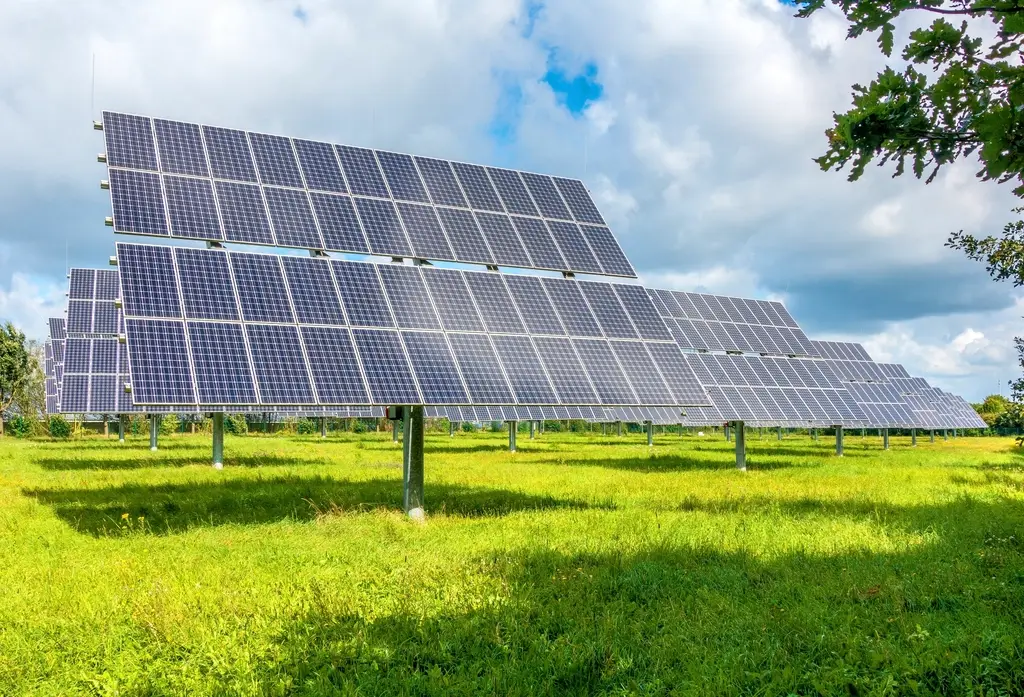 Ground-mounted solarGround-mounted solar on business or farm land: planning, land choice, cable runs, grid connection, security and biodiversity.
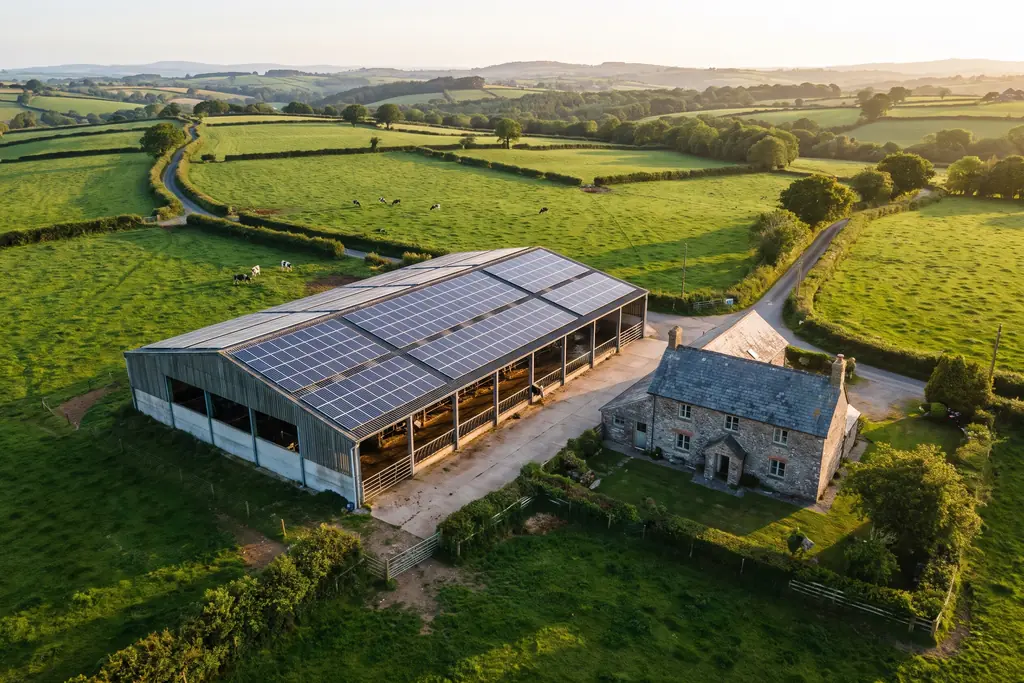 FarmsDairy, poultry and grain enterprises can make good use of solar on sheds or land. A farm survey looks closely at seasonal demand, building condition and rural grid capacity.
- Holiday parksSeasonal demand that peaks in summer lines up with solar output, with reception, leisure and amenity roofs, spare land and EV charging to consider.