
What agrivoltaics means
The government's Land Use Framework for England describes agrivoltaics as "the integration of solar with arable farming" and as "installing solar panels above crops", alongside continued livestock grazing under solar farms (GOV.UK). In everyday use the word, and its variants agrivoltaic, agri PV and solar grazing, covers both.
| Approach | What it looks like | How common in the UK |
|---|---|---|
| Grazing under panels | A standard ground-mounted array, with sheep grazing between and under the rows | Established; many solar farms are designed for it |
| Crops under raised panels | Panels mounted high or widely spaced so crops grow and machinery can pass beneath | Early; more research has been done in mainland Europe |
How much UK farmland carries solar now
Defra's June 2026 survey of agricultural holdings in England found 9.4 thousand hectares of land used for solar panels, of which "just under half of this area (4.4 thousand hectares) is also grazed or used for agriculture production" (Defra).
The government's Solar Roadmap (30 June 2025) estimates that solar farms take about 0.1% of total UK land today and up to 0.4% by 2030 (GOV.UK). It also says "Many solar projects are designed to enable continued livestock grazing" and that government is working to understand the opportunities agrivoltaics offers.
The planning position in England
There is no separate planning category for agrivoltaics. A field array is treated as ground-mounted solar and almost always needs full planning permission; see solar on agricultural land for the application itself. What has changed is how policy talks about dual use.
- Land quality still comes first. The National Planning Policy Framework asks decision makers to take into account the quality of agricultural land, including best and most versatile (BMV) land (Agricultural Land Classification grades 1, 2 and 3a), and to use poorer land where significant development of farmland is necessary (NPPF, natural environment).
- Large schemes. The 2025 National Policy Statement for renewable energy (EN-3), published on 6 January 2026, applies to solar over 100 MW in England. It says poorer quality land should be preferred, that ground-mounted solar "is not prohibited" on BMV land, and that decision makers can consider "whether the proposal allows for continued agricultural use and/or can be co-located with other functions" (paragraphs 2.10.21 to 2.10.24). It also encourages a Soil Resources and Management Plan (GOV.UK).
- The Solar Roadmap keeps planning protections for the best agricultural land: where agricultural land is needed, lower quality land should be preferred, and a developer proposing to use BMV land must justify it.
- The Land Use Framework says solar and wind will remain a small share of land use, that there will be opportunities to keep farming alongside them, and that the aim is to keep more of the best and most versatile land producing food (GOV.UK).
For a farm, the practical reading is that showing the land will keep producing food, through grazing or cropping, strengthens an application, but it does not remove the land quality test. An array on grade 3b, 4 or 5 land, sized to the farm's own use, remains the easiest case. Scotland, Wales and Northern Ireland have their own planning policy and land classification.
Evidence and examples
- A grazed solar farm in Norfolk. The Solar Roadmap's case study is David and John Mack's 509-acre farm near Sheringham, where their company Genatec got planning permission in 2013 for a 3.6 MW solar farm on about 20 acres of moderate quality land. The site is grazed by 40 ewes and their lambs from April to October, with the lamb sold to local butchers (GOV.UK).
- Where agrivoltaics could work in Great Britain. A University of Sheffield study published on 26 February 2025 in Applied Energy found that agrivoltaics has enough potential to meet UK government solar targets on its own, with Cambridgeshire, Essex, Lincolnshire and the wider East and South East of England the most suitable areas, chosen for flat farmland, grid connections and sunshine. The researchers note that very little agrivoltaics research has been done in the UK compared with mainland Europe (University of Sheffield).
- Crops under partial shade. The same team's earlier field work in Tanzania and Kenya found maize, Swiss chard and beans thrived under the partial shade of solar panels. Results in a sunnier climate do not transfer directly to British crops and yields.
What a farm should check
- Your own daytime use. A dairy, cold store, grain dryer or workshop that uses power in daylight gets the best return. Start with shed and barn roofs, which avoid the land question; see farm solar.
- Land grade. A detailed Agricultural Land Classification survey settles whether a field is BMV.
- What farming continues. Sheep grazing works under standard arrays. Crops need raised or widely spaced frames, which cost more and leave fewer panels per hectare.
- Tenancy. A tenant farmer needs the landlord's consent. The Solar Roadmap notes that the Agricultural Holdings Act 1986 includes provisions to compensate a tenant for loss of land, and that government wants that compensation to be adequate and fair.
- Tax and grants. Land taken out of agricultural use may be treated differently for inheritance tax, so take advice first. Our farm solar grants page has what was open when we last checked, and ground-mounted solar covers the costs of a field array.
- The grid. A field array big enough to matter will need G99 approval, and a long cable run back to the meter adds cost.
A free site survey with one MCS certified installer matched to your farm looks at the roofs first, then the land, and shows what each option could save.
Note: General information, not planning, land or tax advice.
Sources
Read on 9 November 2026.
- GOV.UK (Defra): The Land Use Framework for England (accessible version, updated 6 May 2026)
- GOV.UK (Defra): Agricultural land use in England at 1 June 2026
- GOV.UK (DESNZ): Solar Roadmap, United Kingdom powered by solar (30 June 2025)
- GOV.UK (DESNZ): National Policy Statement for renewable energy infrastructure (EN-3), 2025
- GOV.UK (MHCLG): National Planning Policy Framework, conserving and enhancing the natural environment
- University of Sheffield: Solar technology could meet UK's electricity needs without sacrificing farmland (26 February 2025)
Frequently asked questions
What is agrivoltaics?
Using the same land for solar panels and farming. England's Land Use Framework describes it as the integration of solar with arable farming, with panels installed above crops, alongside livestock grazing under solar farms. In the UK the common form today is sheep grazing under a ground-mounted array; crops under raised panels are at an early stage.
How much UK farmland is used for agrivoltaics?
Defra's survey of agricultural holdings in England at 1 June 2026 found 9.4 thousand hectares used for solar panels, of which just under half (4.4 thousand hectares) is also grazed or used for agricultural production. The Solar Roadmap estimates solar farms take about 0.1% of UK land today and up to 0.4% by 2030.
Can solar panels go on best and most versatile land?
They are not banned, but they face the hardest test. National policy in England asks decision makers to take land quality into account and to prefer poorer land, and the 2025 EN-3 policy for schemes over 100 MW says solar is not prohibited on BMV land. Keeping the land in use for grazing or crops can help an application but does not replace that test.
Can sheep graze under solar panels?
Yes, and it is the most common form of agrivoltaics in the UK. The government's Solar Roadmap says many solar projects are designed for continued grazing, and its Norfolk case study, a 3.6 MW solar farm on about 20 acres, is grazed by 40 ewes and their lambs from April to October.
Which crops grow under solar panels?
UK field evidence is limited; University of Sheffield researchers say very little agrivoltaics research has been done here compared with mainland Europe. Their field work in Tanzania and Kenya found maize, Swiss chard and beans thrived under partial shade. Crops need raised or widely spaced frames, so a farm should get a design and costs for its own fields before deciding.
Related pages
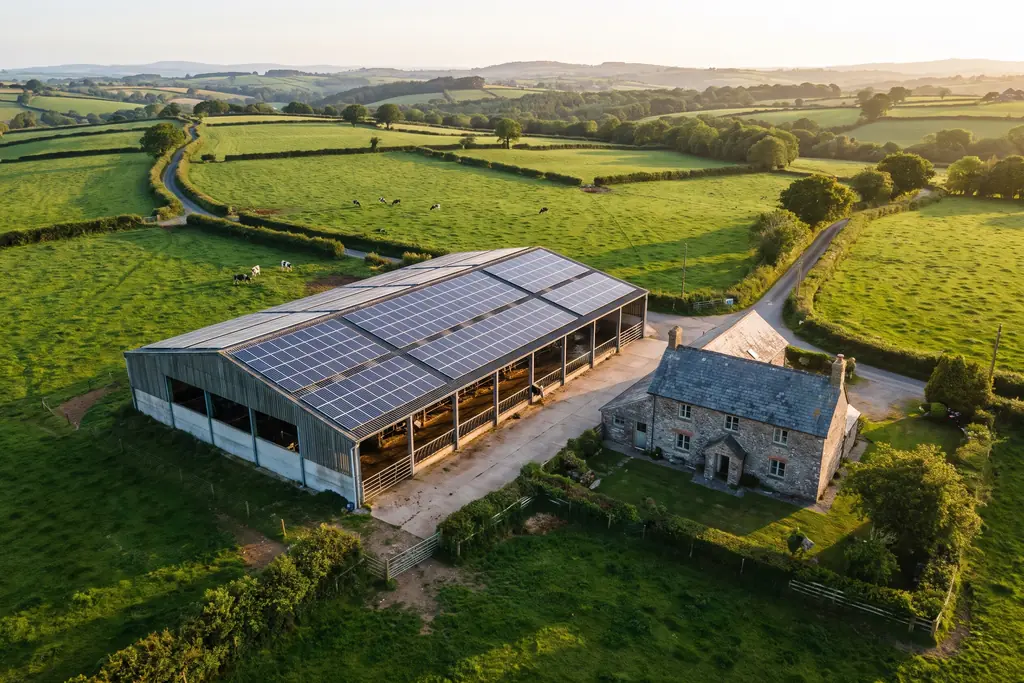 FarmsDairy, poultry and grain enterprises can make good use of solar on sheds or land. A farm survey looks closely at seasonal demand, building condition and rural grid capacity.
- Solar on agricultural landBest and most versatile land, agricultural land classification surveys, grazing between rows, biodiversity and how to make the planning case for a farm array.
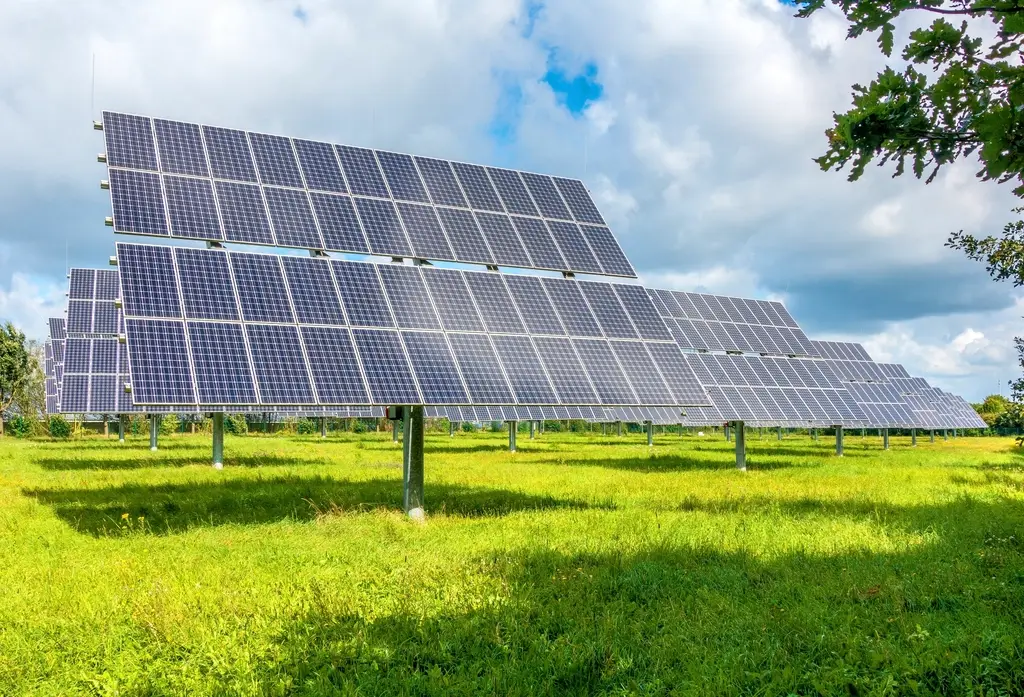 Ground-mounted solarGround-mounted solar on business or farm land: planning, land choice, cable runs, grid connection, security and biodiversity.
- FarmsWhat is open and closed for farm solar in England, Scotland, Wales and Northern Ireland, and the tax and rates rules that apply anyway.
- Arable farmsBig barn and grain store roofs meet seasonal demand from drying and ventilation, so sizing to use, not roof area, decides the case.
- Planning permissionPermitted development for commercial rooftop solar and car park canopies in England, prior approval, heritage limits, ground-mounted schemes and the other UK nations.