
Who needs a Display Energy Certificate?
A DEC shows how much energy a building actually used over a year, as a rating from A to G. In England and Wales the duty sits with the occupier, under regulation 14 of the Energy Performance of Buildings (England and Wales) Regulations 2012 (legislation.gov.uk). A building needs one when all of these are true:
| Test | The rule |
|---|---|
| Who occupies it | A public authority, in whole or in part |
| Who visits | The building is frequently visited by the public |
| Size | Total useful floor area over 250m² (the threshold fell from 500m² on 9 July 2015) |
| The building | It has a roof and walls and uses energy to condition the indoor climate: heating, mechanical ventilation or air conditioning |
Sources: GOV.UK DEC guide and regulation 14. The floor area is the gross floor area measured under RICS guidance (regulation 2). Part of a building designed or altered to be used separately can count on its own.
Two points catch people out:
- Private organisations do not need one, even when they share a building with a public body, though any business may display a DEC voluntarily (GOV.UK guide).
- The occupier holds the duty, not the owner. The guide's own FAQ says a DEC is not needed for a building a public authority lets to a private company for business that is not a public service. If you are a commercial landlord with a council or NHS tenant, the certificate is theirs to keep up.
The guide does not list who counts as a public authority. If you are unsure, an accredited DEC assessor can tell you whether your building is in scope.
How long a DEC lasts
| Total useful floor area | DEC valid for | Advisory report valid for |
|---|---|---|
| Over 1,000m² | 12 months | 7 years |
| 250m² to 1,000m² | 10 years | 10 years |
Source: GOV.UK DEC guide. The 12 months run from the DEC's nominated date, which the assessor sets no later than three months after the end of the year the rating covers (regulation 2). A DEC for a building over 1,000m² also shows the ratings for the previous two years where they exist, so a fall in energy use shows up as a trend on the wall.
The A to G operational rating
The rating compares the building's carbon dioxide emissions per square metre with a typical building of the same type:
Operational rating = (building CO2 emissions ÷ floor area) × (100 ÷ typical CO2 emissions per unit area)
A typical building scores 100. Zero emissions scores 0, and twice the typical emissions scores 200 (GOV.UK methodology).
| Operational rating | Band |
|---|---|
| 0 to 25 | A |
| 26 to 50 | B |
| 51 to 75 | C |
| 76 to 100 | D |
| 101 to 125 | E |
| 126 to 150 | F |
| More than 150 | G |
Source: GOV.UK methodology for operational ratings, section 3.7. The assessment period is 365 days of metered energy, from meter readings or fuel delivery notes, and the benchmark is corrected for weather and occupancy. The certificate splits the CO2 into three headings: heating, electricity and renewable.
The penalties
| Failure | Penalty charge notice |
|---|---|
| Not displaying a DEC at all times in a prominent place | £500 |
| Not having a valid advisory report | £1,000 |
Source: GOV.UK DEC guide. Local authorities enforce the rules. A notice must be withdrawn if you show you took all reasonable steps to comply, and you can appeal to the county court within 28 days. The DEC must be at least A3 and "in a prominent place clearly visible to the public at all times".
Scotland and Northern Ireland
| Nation | What public buildings must display |
|---|---|
| England and Wales | A DEC, under the 2012 Regulations, as above |
| Scotland | An Energy Performance Certificate, not a DEC. A building over 250m² occupied by a public authority and visited by the public at least weekly must display its EPC (SSI 2008/309, regulation 9) |
| Northern Ireland | A DEC, for buildings over 250m² (from 9 July 2015) occupied by a public authority or an institution providing a public service and frequently visited by the public. The Department of Finance says the DEC is valid for one year and the advisory report for seven (Department of Finance) |
In Scotland the EPC shows the building's design rating, not its metered use, so solar changes it through the assessor's model rather than your meter readings. Our MEES and commercial EPC guide covers EPCs.
How solar panels change a DEC
Because a DEC is built from meter readings, solar works on it in the simplest way: you buy less electricity. The government methodology says that where there is on-site generation from a renewable source, "this would be reflected in a reduced grid mains electricity demand. Consequently, meter readings are not adjusted" (GOV.UK methodology, 3.3.4).
- Solar you use on site lowers the metered import, so the electricity CO2 and the rating both fall.
- The renewable heading: the energy your panels produce can be shown on the certificate and in its technical table, with the CO2 it avoided shown as a negative figure.
- Exports are only taken off if they are metered. The methodology says energies are measured net of exports, but where exported energy "is not metered or is metered over periods that are outside these acceptable tolerances", it cannot be counted, and "estimates are not acceptable".
- The floor is zero. A building that generates more than it uses is still rated 0; the rating cannot go below zero.
So if your solar has an export meter, give the readings to the assessor along with the import readings.
Example: How much the electricity side of a DEC could fall (illustrative)
Take the illustrative 300,000 kWh a year electricity user used across this site, this time as a public building. A 100 kWp rooftop system generates about 90,000 kWh a year (900 kWh per kWp), and 80% of it, 72,000 kWh, is used on site.
Metered grid electricity falls from 300,000 kWh to 228,000 kWh, a cut of 24%
The electricity CO2 on the DEC falls by the same 24%, because it is the metered kWh multiplied by the government's carbon factor
How far the whole rating moves depends on how much of the building's CO2 comes from heating, which solar does not touch. The assessor works out the real figure.
That illustrative system costs about £90,000 at an illustrative £900 per kWp and saves about £18,180 a year at an illustrative 24p per kWh (80% used on site, 20% exported at 5p), a simple payback of roughly 5 years. Public bodies in England should check what is open under Salix and the Public Sector Decarbonisation Scheme.
The advisory report
The advisory report lists measures to improve the building's energy performance, grouped by payback: short term (under three years), medium term (three to seven years) and long term (over seven years), usually five to ten in each group. It can include "opportunities for the installation of low and zero carbon (LZC) technologies" such as solar (GOV.UK guide). Acting on it is not compulsory.
A recommendation to "consider solar PV" is a starting point, not a design. A site survey checks the roof, the structure and the grid connection, and uses your half-hourly data to work out how much of the output you would use in daylight. See energy data analysis.
Getting a DEC and checking an existing one
- Find an accredited assessor. Only an energy assessor accredited to produce DECs can produce and lodge one; your own staff can do it if they meet an accreditation scheme's standards.
- Collect 12 months of meter readings for every fuel, plus any heat or electricity bought from a district scheme. Half-hourly data, where you have it, also shows when you use power; see half-hourly meters.
- The assessor lodges the DEC on the national register, with a unique reference number. You cannot opt out of the register.
- Display it at A3 or larger where visitors will see it, and diary the renewal.
You can look up any public building's current DEC on GOV.UK (check a public building's DEC), or search the register by postcode (find an energy certificate).
Where DECs fit for schools, councils and hospitals
Many of the buildings that need a DEC, such as schools, council buildings, healthcare sites and leisure centres, use much of their power in daylight, which is when solar generates. For a building over 1,000m², the DEC on the wall is a yearly record of whether the energy work is landing. A whole-site business energy audit finds the waste to cut first; a free solar survey shows what the panels would do with the load that is left.
Note: General information from GOV.UK, legislation.gov.uk and the Department of Finance, not legal advice. Check the current rules with an accredited assessor.
Sources
Read on 27 November 2026.
- GOV.UK: A guide to display energy certificates and advisory reports for public buildings (updated 10 August 2015)
- GOV.UK: The government methodology for operational ratings, display energy certificates and recommendation reports
- legislation.gov.uk: Energy Performance of Buildings (England and Wales) Regulations 2012, regulation 14
- legislation.gov.uk: Energy Performance of Buildings (England and Wales) Regulations 2012, regulation 2
- legislation.gov.uk: Energy Performance of Buildings (Scotland) Regulations 2008, regulation 9
- Department of Finance (Northern Ireland): Display energy certificates
- GOV.UK: Check a public building's Display Energy Certificate
Frequently asked questions
Which buildings need a Display Energy Certificate?
In England and Wales, a building with a total useful floor area over 250m², occupied in whole or part by a public authority and frequently visited by the public, must display a DEC. It must have a roof and walls and use energy for heating, mechanical ventilation or air conditioning. Private organisations do not need one, even if they share the building.
How long is a DEC valid for?
For a building over 1,000m², the DEC is valid for 12 months and the advisory report for 7 years. For a building from 250m² to 1,000m², both last 10 years. In Northern Ireland the Department of Finance says a DEC is valid for one year and the advisory report for seven.
What is the fine for not displaying a DEC?
A penalty charge notice of £500 for failing to display a valid DEC at all times in a prominent place, and £1,000 for not having a valid advisory report. The notice must be withdrawn if you show you took all reasonable steps to comply, and you can appeal to the county court within 28 days.
What is a good DEC rating?
A typical building of its type scores 100, which is the top of band D. Band A is 0 to 25, B 26 to 50, C 51 to 75, D 76 to 100, E 101 to 125, F 126 to 150 and G anything over 150. A lower number means lower carbon dioxide emissions per square metre than the benchmark.
Do solar panels improve a DEC rating?
Yes. A DEC uses metered energy, so solar electricity you use on site lowers the electricity you buy and the CO2 behind the rating. Exported power can be taken off as well, but only if it is metered; estimates are not accepted. The energy your panels produce can be shown under the certificate's renewable heading.
Do Scottish public buildings need a DEC?
No. Scotland uses Energy Performance Certificates instead. A building over 250m² occupied by a public authority and visited by the public at least weekly must display its EPC, under regulation 9 of the Energy Performance of Buildings (Scotland) Regulations 2008. Northern Ireland does use DECs.
Related pages
- MEES and commercial EPCsLandlords of let commercial property must meet a minimum EPC rating; solar is one of the measures that can lift a rating.
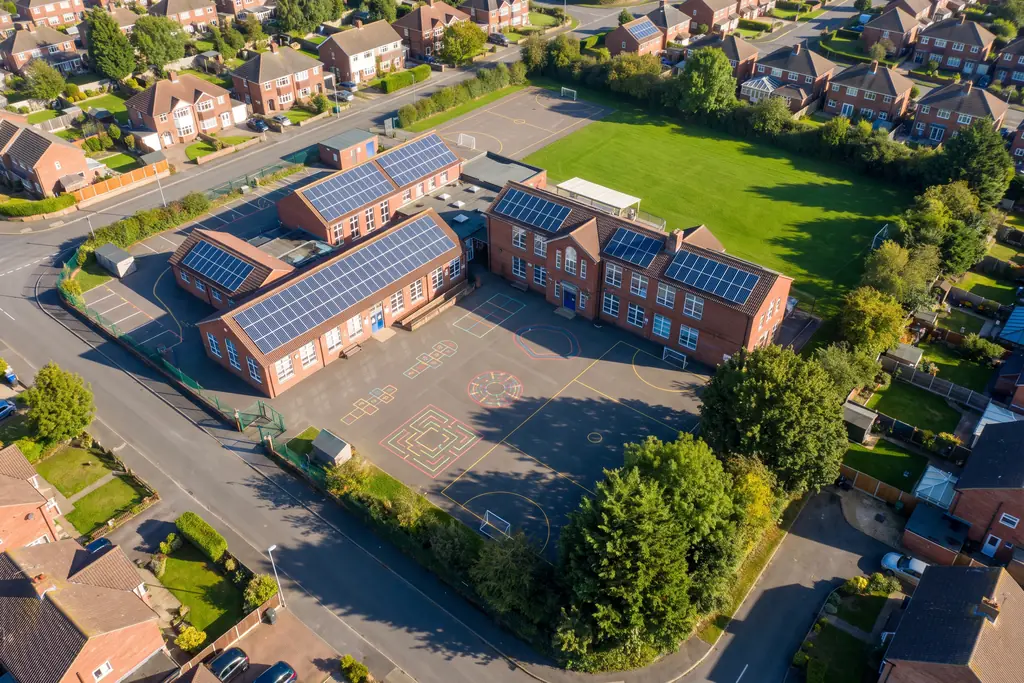 SchoolsSchools, academies and colleges have daytime demand but long summer closures. The survey models term-time use against holiday export and flags building and approval issues early.
- HealthcareContinuous demand in care homes and daytime clinical loads in surgeries and clinics suit solar. The survey focuses on backup power, fire strategy, occupied buildings and lease arrangements.
- Sports and leisureLeisure centres with pools use power all day; clubs used mostly in the evening need a closer look at timing, batteries and community funding.
- Public sector solar fundingFor schools, councils, NHS trusts and universities: the PSDS position, what Salix funds now in each nation, Great British Energy solar and how to buy through a framework.
- Business energy auditWhat an energy audit covers, the four steps to do one yourself, what to bring, the free and funded help in each UK nation, and where solar fits in the action plan.